
3 Days in Cairo: The Perfect Travel Itinerary
Three days is enough to experience the major sides of Cairo without turning your trip into a nonstop checklist.
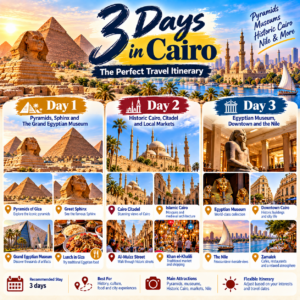
The trick is to organize your time geographically. Spend one day around the Giza pyramids and ancient Egyptian sites, another exploring Historic Cairo and its Islamic architecture, and the third combining a major museum with Downtown Cairo, the Nile, or Zamalek.
Cairo can be demanding. Traffic is unpredictable, distances can look deceptively short on a map, and many historic areas are best explored on foot. A good itinerary therefore needs breathing room.
This 3-day Cairo itinerary focuses on the experiences that give first-time visitors a useful introduction to the city: the Pyramids of Giza and Sphinx, the Grand Egyptian Museum, Al-Muizz Street, Khan el-Khalili, the Citadel, Historic Cairo, the Egyptian Museum, Downtown, and the Nile.
It also leaves enough flexibility to stop for Egyptian food, coffee, photographs, and the occasional unplanned discovery.
Cairo in 3 Days at a Glance
Day 1: Giza Pyramids + Great Sphinx + Grand Egyptian Museum
Day 2: Historic Cairo + Citadel + Al-Muizz Street + Khan el-Khalili
Day 3: Egyptian Museum + Downtown Cairo + Nile + Zamalek
This arrangement is not the only way to visit Cairo, but it avoids one of the most common mistakes: spending hours crossing the city between attractions that could have been visited together.
Day 1: Pyramids, Sphinx and Ancient Egypt
Your first day should begin with the sight most travelers associate with Cairo: the Pyramids of Giza.
The Giza Plateau is part of the UNESCO-listed Memphis and its Necropolis, a large archaeological property extending from Giza through other ancient sites including Saqqara and Dahshur. The property contains the Great Pyramid of Khufu, the pyramids of Khafre and Menkaure, the Great Sphinx, and numerous other monuments.
Morning: Explore the Pyramids of Giza
Start as early as practical.
The pyramids are much easier to appreciate before you have spent several hours in the Cairo heat and crowds. More importantly, arriving with enough time allows you to explore the plateau instead of rushing directly to the most famous viewpoint.
Begin with the three main pyramids:
- Great Pyramid of Khufu
- Pyramid of Khafre
- Pyramid of Menkaure
Do not assume that the three pyramids are the entire attraction. The Giza Plateau also contains smaller pyramids, tombs, temples, mastabas, and remains associated with the people who built and maintained the ancient complex.
Walk between viewpoints where practical and give yourself time to appreciate the changing perspectives.
If entering one of the pyramids is important to you, check the current ticket arrangements before your visit and decide in advance rather than making the choice after arriving.
Late Morning: Visit the Great Sphinx
After exploring the pyramids, continue to the Great Sphinx.
The monument was carved from the limestone bedrock and is associated with the pyramid complex of Khafre. It stands beside the Valley Temple, giving you another perspective on the scale and organization of the Giza complex.
This is also one of the best places to pause for photographs.
Rather than rushing from the pyramids to the Sphinx, look back toward the plateau. The relationship between the Sphinx, Valley Temple, and pyramids is part of what makes this area so impressive.
Lunch: Eat Near Giza
By lunchtime, leave the archaeological site and have a proper meal.
You can choose between a restaurant with pyramid views, a hotel restaurant, or a more casual Egyptian meal.
Try something local such as:
- Koshari
- Ful and taameya
- Grilled meats
- Egyptian rice and vegetables
- Fresh juices
There is no need to make lunch complicated. The afternoon will involve another major attraction.
Afternoon: Grand Egyptian Museum
Spend the second half of the day at the Grand Egyptian Museum.
Its location near the Giza Plateau makes it particularly convenient to combine with the pyramids. The museum’s official tourism information currently lists the complex as open daily from 8:30 AM to 6 PM, with the galleries operating from 9 AM to 5 PM and last ticket purchase listed at 4 PM. Because opening arrangements can change, check the official information shortly before visiting.
The museum is particularly significant for travelers interested in Tutankhamun. Its galleries present more than 6,000 artifacts connected with the young king, including objects associated with his life, rule, burial, and afterlife.
Do not underestimate the time required here.
If you are passionate about ancient Egypt, you could spend most of the afternoon inside. If museums are not your main interest, two to three hours can provide a useful introduction without exhausting you.
Evening: Keep It Easy
After a full day of pyramids and museum galleries, avoid scheduling another major attraction.
Have dinner near your hotel or choose a restaurant with a view.
If your accommodation is in Giza, this is a good evening to enjoy the pyramids from a rooftop or restaurant rather than immediately returning to another sightseeing district.
Day 1 works because: the Giza Plateau and Grand Egyptian Museum are naturally compatible, reducing unnecessary cross-city travel.
Day 2: Historic Cairo, Citadel and Khan el-Khalili
Day two is about a completely different Cairo.
Instead of ancient Egypt, you will spend the day exploring the city’s Islamic and medieval heritage.
Historic Cairo is a UNESCO World Heritage Site and contains an exceptional concentration of mosques, madrasas, markets, historic streets, and other monuments. UNESCO describes the area as a remarkable survival of historic urban fabric rather than simply a collection of isolated buildings.
Morning: Cairo Citadel
Begin at the Citadel of Saladin.
The Citadel occupies an elevated position overlooking Cairo and became an important center of government during the Ayyubid period. Historic Cairo’s heritage developed through successive Fatimid, Ayyubid, Mamluk, and Ottoman periods, leaving the city with several distinct architectural layers.
The location also gives you a useful introduction to Cairo’s geography.
From the Citadel, you can look across the dense urban landscape and understand how the historic city developed around the Nile and the surrounding hills.
Visit the Mosque of Muhammad Ali
Inside the Citadel, visit the Mosque of Muhammad Ali.
Its Ottoman architectural influence makes it visually different from many of the Mamluk monuments elsewhere in Historic Cairo. The mosque was built within the Citadel complex during the 19th century.
Take time to look at the interior rather than treating the mosque as a quick photo stop.
The large central space, domes, minarets, and decorative details provide a useful contrast with the medieval architecture you will see later in the day.
Late Morning: Sultan Hassan and Al-Rifa’i
Continue toward the area around Sultan Hassan Mosque and Al-Rifa’i Mosque.
Sultan Hassan is one of Cairo’s monumental Mamluk buildings, while Al-Rifa’i stands opposite it, creating one of the city’s most striking architectural combinations.
You do not need to spend hours inside each building.
The main value of this stop is seeing the scale of the architecture and understanding how Cairo’s rulers used monumental religious buildings to shape the city’s skyline.
Lunch in Historic Cairo
Have lunch before continuing into the denser streets of Old Cairo.
This is a good time to try traditional Egyptian food rather than eating at an international chain.
Depending on where you are, look for dishes such as:
- Molokhia
- Mahshi
- Fattah
- Koshari
- Grilled chicken or meat
- Egyptian bread with dips and salads
Keep lunch relatively relaxed. The afternoon is best experienced slowly.
Afternoon: Al-Muizz Street
Now move into the heart of Historic Cairo.
Al-Muizz Street is one of the best places to experience Cairo’s Islamic architectural heritage on foot. The street forms part of Historic Cairo and runs through an area filled with monuments, historic buildings, workshops, shops, and traditional cafés.
This is where you should resist the temptation to rush.
Instead of planning to visit every building, walk, look around, enter selected monuments, and pay attention to the details.
Historic Cairo is valuable partly because the historic buildings remain integrated into living neighborhoods. UNESCO notes that the area’s significance extends beyond individual monuments to the surviving urban fabric, streets, markets, and neighborhoods.
Explore the Side Streets
Leave yourself some time to wander away from the main route.
You will encounter traditional workshops, small cafés, old doorways, architectural details, and streets that feel very different from modern Cairo.
This is one of the moments in the itinerary where an experienced local guide can be particularly useful because the historical context is not always obvious from the buildings themselves.
Late Afternoon and Evening: Khan el-Khalili
Finish the Historic Cairo day at Khan el-Khalili.
The famous bazaar sits within the old city and is closely associated with the traditional commercial life of Cairo. Experience Egypt describes the area as a maze of old streets and alleys filled with crafts, artisans, shops, and traditional cafés.
You can shop for:
- Spices
- Traditional lamps
- Handmade crafts
- Jewelry
- Leather goods
- Egyptian souvenirs
But you do not need to buy anything to enjoy the area.
One of the best ways to experience Khan el-Khalili is to wander without a strict shopping list.
Stop for Egyptian tea or another drink and watch the movement around you.
Evening: Traditional Café
After walking through the market, sit down for a drink.
You can make this a short stop before dinner or turn it into a relaxed evening.
If there is a scheduled cultural performance at Wikalat al-Ghuri during your visit, it can also be an interesting addition. Experience Egypt lists the venue among Cairo’s cultural experiences and highlights whirling dervish performances there.
Check the current schedule before planning around a performance.
Day 2 works because: the Citadel, Sultan Hassan area, Al-Muizz, and Khan el-Khalili all belong to the broader Historic Cairo experience, so you are spending most of the day exploring one part of the city rather than sitting in traffic.
Day 3: Museums, Downtown Cairo and the Nile
The third day is intentionally more flexible.
After two intensive sightseeing days, you can choose between a history-focused morning and a slower afternoon in central Cairo.
For most first-time visitors, the combination of the Egyptian Museum, Downtown, and the Nile provides a good final day.
Morning: The Egyptian Museum in Tahrir
Start your day at the Egyptian Museum.
Located in Downtown Cairo, the museum houses an extensive collection of ancient Egyptian antiquities covering periods from the Predynastic era through the Greco-Roman period. Its collection includes statues, papyri, sarcophagi, jewelry, and other archaeological objects.
The museum’s official information currently lists opening hours of 9 AM to 5 PM, with the ticket window closing at 4 PM. Check the official museum information before your visit because schedules can change.
You have already visited GEM, so do not feel that you need to spend the entire day here.
Instead, focus on the objects and periods that interest you most.
This museum is particularly useful as a complement to GEM because the two institutions offer different experiences rather than simply being identical versions of the same attraction.
Late Morning: Tahrir Square and Downtown Cairo
After the museum, walk around Downtown.
Known locally as Wust al-Balad, Downtown combines 19th-century architecture with cafés, shops, restaurants, cultural spaces, and everyday city life. Experience Egypt describes walking as one of the best ways to appreciate the district’s architecture and atmosphere.
You do not need a rigid sightseeing route.
Walk through a few of the central streets, stop for coffee, and take in the contrast with Historic Cairo.
This is also a useful reminder that Cairo is not an archaeological museum. Millions of people live, work, eat, shop, and socialize in the same city surrounding the monuments visitors come to see.
Lunch: Try More Egyptian Food
Use your third day for another local meal.
If you have not yet tried them, consider:
Koshari: rice, lentils, pasta, chickpeas, tomato sauce, and fried onions.
Taameya: Egypt’s version of falafel, traditionally made from fava beans.
Fattah: a richer dish based around bread, rice, meat, and a seasoned sauce.
Molokhia: a distinctive Egyptian dish usually served with rice or bread and meat or poultry.
Food is one of the easiest ways to make a short Cairo trip feel less like a sequence of tourist attractions.
Afternoon: Choose Your Cairo Experience
The afternoon of day three should depend on your interests.
You have several good options.
Option 1: National Museum of Egyptian Civilization
If you want more history, visit the National Museum of Egyptian Civilization, or NMEC.
The museum presents Egyptian civilization across different periods rather than concentrating exclusively on the pharaonic era. Its collection includes the Royal Mummies, presented in a dedicated display.
The official museum information currently lists regular hours as 9 AM to 5 PM, with additional evening hours on some days. Since hours and special schedules can change, verify them before visiting.
Choose NMEC instead of adding another attraction if museums are one of the main reasons you came to Egypt.
Option 2: Zamalek
If you are ready for a break from ancient history, go to Zamalek.
This leafy island district has restaurants, cafés, bookstores, galleries, and cultural institutions. Experience Egypt describes Zamalek as a contemporary neighborhood with a strong artistic and cultural identity.
Take a slow walk, have coffee, and enjoy a less intense side of Cairo.
Option 3: Cairo Tower
If you want a city view, head toward Cairo Tower in Zamalek.
The tower stands 187 meters high and provides broad views over Cairo and the Nile.
It can work particularly well toward late afternoon, although exact sunset timing and operating arrangements vary by season.
Option 4: Manial Palace
Another possibility is Manial Palace.
The palace was built by Prince Muhammad Ali Tewfik between 1899 and 1929 and combines several architectural influences, including Ottoman, Andalusian, Persian, and European styles.
This is a good choice if you have already seen enough archaeological sites and want something connected to Egypt’s more recent royal history.
Evening: Finish Beside the Nile
End your three days in Cairo beside the Nile.
You can simply walk along the river, sit at a café, or choose a short boat trip.
A Nile cruise is not essential to understanding Cairo, but it gives you a different perspective after two days spent exploring streets and monuments.
If you prefer something simple, a riverside dinner or an evening walk may be enough.
The point of the final evening is not to add another major landmark. It is to give you time to look back at the city you have just spent three days exploring.
Where to Stay for a 3-Day Cairo Itinerary
Your hotel location can have a noticeable effect on this itinerary.
Giza
Staying in Giza makes day one particularly convenient.
It is a logical choice if seeing the pyramids is the main priority or if you want a hotel with pyramid views.
The trade-off is that you will spend more time traveling toward Downtown and Historic Cairo.
Downtown Cairo
Downtown is useful for travelers who want central access to the Egyptian Museum, Tahrir Square, the Nile, and several city neighborhoods.
It also makes the third day especially easy.
Zamalek
Zamalek offers a quieter residential atmosphere while remaining relatively central.
It has restaurants, cafés, galleries, and access to Cairo Tower and the Nile.
For travelers who prefer having restaurants and cafés nearby after sightseeing, it can be a convenient base.
New Cairo
New Cairo can offer modern hotels and residential areas, but it is farther from many traditional tourist attractions.
If you choose to stay there, allow additional travel time for Giza and Historic Cairo.
How to Get Around Cairo in 3 Days
Cairo is not a city where you should plan every movement around walking distance.
The major sightseeing areas are separated by busy roads and the Nile, and traffic can significantly affect journey times.
A practical approach is:
Use a car or ride-hailing service between major districts.
Walk once you arrive in Historic Cairo or Downtown.
Avoid scheduling attractions on opposite sides of the city back-to-back.
Leave extra time for airport transfers and important appointments.
For the Giza day, keep the entire morning and afternoon concentrated around Giza and the museum.
For Historic Cairo, stay within the same general district for most of the day.
For day three, keep Downtown, the Egyptian Museum, the Nile, and Zamalek as your main area.
What to Eat During 3 Days in Cairo
You do not need an elaborate food itinerary.
Instead, use meals to sample a few distinctly Egyptian dishes.
Try koshari at least once. It is inexpensive, filling, and widely associated with everyday Egyptian food.
Try taameya for breakfast or a quick meal.
Order ful with Egyptian bread if you want a simple traditional breakfast.
For a larger meal, look for grilled meat or chicken, molokhia, mahshi, or fattah.
And leave room for desserts such as basbousa, kunafa, or umm ali.
Cairo’s food scene ranges from very casual local restaurants to sophisticated dining, so your budget does not need to determine whether you eat well.
Is 3 Days Enough for Cairo?
Yes, three days can work very well for a first visit, provided you accept that you cannot see everything.
This itinerary gives you three different versions of the city:
Day 1: Ancient Egypt and the Giza Plateau.
Day 2: Medieval and Islamic Cairo.
Day 3: Museums, modern Cairo, the Nile, and contemporary neighborhoods.
What you should not try to do is add Saqqara, Alexandria, and every major museum to the same three days.
Saqqara is particularly tempting because it belongs to the same wider UNESCO-listed ancient necropolis as Giza. It contains the Step Pyramid of Djoser and important evidence for the development of pyramid architecture.
But adding Saqqara to an already full three-day schedule means sacrificing time elsewhere.
If ancient Egypt is your primary interest, you can replace part of day three with Saqqara.
If this is your first time in Cairo and you want a balanced introduction, keep the three-day structure above.
3-Day Cairo Itinerary: Quick Summary
| Day | Morning | Afternoon | Evening |
|---|---|---|---|
| Day 1 | Giza Pyramids | Great Sphinx + Grand Egyptian Museum | Dinner and rest |
| Day 2 | Citadel + Muhammad Ali Mosque | Al-Muizz Street | Khan el-Khalili |
| Day 3 | Egyptian Museum | Downtown / NMEC / Zamalek | Nile or Cairo Tower |
The itinerary deliberately leaves some choices open because not every traveler wants the same Cairo experience.
Someone fascinated by ancient Egypt may prefer another museum.
Someone interested in architecture may spend longer in Historic Cairo.
Someone who has already visited several museums may prefer Zamalek and the Nile.
That flexibility is more useful than trying to create a schedule that assumes every visitor travels in exactly the same way.
Practical Tips for Your Cairo Trip
Start major outdoor sightseeing early. Giza is much easier to explore when you are not trying to walk around the plateau during the hottest part of the day.
Wear comfortable shoes. Both archaeological sites and Historic Cairo involve substantial walking.
Keep your schedule geographically organized. This is probably the most important practical tip for a short Cairo visit.
Do not underestimate museum time. The Egyptian Museum, GEM, and NMEC can each absorb several hours for travelers who enjoy history.
Carry water. Especially on the Giza day.
Dress appropriately for religious sites. When visiting mosques and churches, choose clothing that is respectful of the setting.
Check official opening hours before visiting. Museum and attraction schedules can change, and some sites have different arrangements on specific days.
Do not fill every evening. Cairo is a city worth experiencing after the formal sightseeing hours are over.
Book important tickets or tours ahead when necessary. This is particularly relevant for attractions with timed entry or changing visitor arrangements.
Final Thoughts
Three days in Cairo will not show you everything, but it can give you a remarkably broad introduction to the city.
Start with the ancient world at Giza and the Grand Egyptian Museum. Move into the medieval city on day two, where the Citadel, Al-Muizz Street, and Khan el-Khalili reveal another layer of Cairo’s history. Then slow the pace on day three with the Egyptian Museum, Downtown, Zamalek, and the Nile.
The most important part of the itinerary is not the exact number of attractions.
It is the rhythm.
Ancient monuments in the morning. A long Egyptian lunch. Historic streets in the afternoon. Coffee beside the Nile in the evening.
That balance gives you enough structure to see the essential Cairo sights without spending your entire three-day trip looking at the clock.
Sources & References
- Experience Egypt — Cairo & Giza
- Experience Egypt — Giza & Ancient Wonders
- UNESCO — Memphis and its Necropolis
- UNESCO — Historic Cairo
- Experience Egypt — Historic Cairo
- Experience Egypt — Downtown Cairo & City Breaks
- Ministry of Tourism and Antiquities — Egyptian Museum
- Ministry of Tourism and Antiquities — National Museum of Egyptian Civilization
- Experience Egypt — Grand Egyptian Museum