
4 Days in Cairo: A Complete Itinerary
Four days in Cairo gives you something that a shorter visit cannot: time to slow down.
With two days, most travelers have to choose between ancient monuments, museums, Islamic Cairo, and the modern city. With four days, you can experience all of them without turning every morning into a race against the clock.
The best approach is to organize each day around a particular part of Cairo.
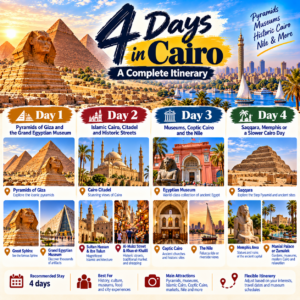
Start with the Pyramids of Giza and the Grand Egyptian Museum. Spend the second day exploring Islamic Cairo and its historic streets. Use the third day for the Egyptian Museum, Coptic Cairo, and the Nile. Then use the fourth day to go deeper into Cairo’s history or take a half-day trip to Saqqara.
This itinerary is designed for a first-time visitor who wants a balanced experience rather than simply checking off as many attractions as possible.
4 Days in Cairo at a Glance
Day 1: Pyramids of Giza + Great Sphinx + Grand Egyptian Museum
Day 2: Citadel + Sultan Hassan + Ibn Tulun + Al-Muizz Street + Khan el-Khalili
Day 3: Egyptian Museum + Coptic Cairo + NMEC or Downtown + Nile
Day 4: Saqqara + Memphis area, or a slower Cairo day with Zamalek, Manial Palace and Downtown
The order can be adjusted depending on your hotel location, museum schedules, weather, and personal interests.
Day 1: Pyramids of Giza and the Grand Egyptian Museum
Your first day begins with the most famous ancient monuments in the Cairo area.
Although the Pyramids of Giza are technically in Giza rather than central Cairo, they are an essential part of almost every first-time Cairo itinerary.
The Giza pyramid fields form part of the UNESCO World Heritage property known as Memphis and its Necropolis, which extends across a large archaeological landscape from Giza toward Dahshur.
Morning: The Pyramids of Giza
Start your day early.
The Giza Plateau is much easier to explore when you have several hours ahead of you rather than arriving late in the day and trying to rush through the site.
The main monuments include:
- Great Pyramid of Khufu
- Pyramid of Khafre
- Pyramid of Menkaure
- Great Sphinx
- Valley Temple
- Numerous tombs and smaller monuments
The Great Pyramid is the obvious centerpiece, but try not to spend your entire visit standing at one viewpoint.
Walk around the plateau and look at the pyramids from different angles. The changing perspective makes their enormous scale much easier to appreciate.
The wider archaeological site also provides evidence of the workers, officials, tomb owners, and institutions that supported the construction and operation of the pyramid complex.
How Long Should You Spend at Giza?
For a comfortable visit, allow roughly three hours.
You may need longer if you want to enter one of the pyramids, visit additional tombs, or spend significant time photographing the site.
If ancient Egyptian history is your main interest, there is no need to rush.
The Great Sphinx
Continue to the Great Sphinx after exploring the pyramids.
The Sphinx is closely associated with the Giza complex and stands near the Valley Temple.
Rather than treating it as a separate attraction requiring a long journey, include it as part of your Giza visit.
Spend time looking back toward the pyramids from the Sphinx area. The relationship between the monuments becomes much clearer from this perspective.
Lunch Near Giza
After several hours outdoors, stop for lunch.
A restaurant with a pyramid view can make the meal part of the experience, but you can also choose a casual Egyptian restaurant.
Good dishes to look for include:
- Koshari
- Taameya
- Ful
- Grilled meat
- Grilled chicken
- Egyptian rice
- Fresh juices
Keep lunch relatively relaxed but do not spend the entire afternoon here.
Afternoon: Grand Egyptian Museum
The Grand Egyptian Museum is an obvious companion to the Giza Plateau because of its location near the pyramids.
The museum’s official visitor information currently lists the galleries as open from 9 AM to 6 PM, with extended gallery hours until 9 PM on Wednesdays and Saturdays. The wider complex opens earlier, and last entry varies according to the closing time.
Check the official schedule before your visit because museum hours and visitor arrangements can change.
GEM presents ancient Egyptian collections on a huge scale. Its Tutankhamun galleries contain more than 6,000 artifacts associated with the young king, while the complex also includes the Grand Hall, Grand Staircase, Khufu’s Boats Museum, gardens, and other visitor areas.
How Long Should You Spend at GEM?
Allow at least three hours.
If ancient Egypt is your main interest, four or five hours would not be unusual.
Do not worry about seeing every object.
Choose the galleries that interest you most and give yourself time to actually look at the objects rather than moving continuously from one display to another.
Evening: Dinner and Rest
After Giza and GEM, keep the evening easy.
If you are staying in Giza, have dinner with a pyramid view.
If you are staying closer to central Cairo, head back toward your hotel and find a nearby restaurant.
You have three more days ahead, so there is no reason to turn the first evening into another sightseeing session.
Day 2: Islamic Cairo and Khan el-Khalili
Day two introduces you to a completely different Cairo.
Instead of ancient Egyptian monuments, you will spend most of the day around medieval Islamic architecture and historic neighborhoods.
Historic Cairo is a UNESCO World Heritage Site and contains a dense collection of mosques, madrasas, markets, historic streets, and monuments from different periods.
This is a day for walking.
Morning: Cairo Citadel
Begin at the Citadel of Saladin.
The Citadel occupies an elevated position overlooking Cairo and was one of the city’s major centers of political power for centuries.
The location also provides an excellent introduction to Cairo’s geography.
From the Citadel, the city spreads out in almost every direction, showing just how densely populated the modern capital has become.
Mosque of Muhammad Ali
Inside the Citadel, visit the Mosque of Muhammad Ali.
Its Ottoman-inspired architecture makes it visually different from the Mamluk buildings you will see later in the day.
The mosque’s domes and minarets dominate the Citadel skyline, while the interior provides another example of how Cairo continued to evolve long after the medieval period.
Experience Egypt identifies the Citadel and Muhammad Ali Mosque among the major landmarks of Cairo’s Islamic heritage.
Late Morning: Sultan Hassan and Al-Rifa’i
Continue to the area around Sultan Hassan Mosque and Al-Rifa’i Mosque.
Sultan Hassan is one of the most imposing examples of Mamluk architecture in Cairo.
The two monuments stand opposite each other and create one of the city’s most impressive architectural scenes.
You do not need to spend a huge amount of time inside both buildings.
Focus on the architecture, scale, courtyards, entrances, and decorative details.
Lunch in Historic Cairo
Have lunch before continuing into the older streets.
This is a good opportunity to try a traditional Egyptian meal.
Choose somewhere convenient rather than spending a large part of your day searching for a particular restaurant.
Your afternoon will be spent mostly on foot.
Afternoon: Ibn Tulun Mosque
Make your way toward the Mosque of Ibn Tulun.
Dating to the 9th century, Ibn Tulun is one of Cairo’s major early Islamic monuments. Experience Egypt describes it as a large mosque dating to 879 and includes it among the city’s important Islamic heritage sites.
Its spacious courtyard gives the building a different atmosphere from the more enclosed historic mosques elsewhere in Cairo.
Take time to look at the geometry of the courtyard, the arches, and the distinctive spiral minaret.
If you are interested in Islamic architecture, this is a stop worth slowing down for.
Continue to Al-Muizz Street
From here, continue toward Al-Muizz Street and the surrounding Historic Cairo district.
Al-Muizz is one of the most rewarding streets in the city for visitors interested in architecture.
The area contains mosques, madrasas, mausoleums, historic houses, commercial buildings, workshops, and traditional streets.
The best approach is not to plan every monument by the minute.
Walk.
Stop when something catches your attention.
Look at the carved stone entrances and wooden details above the shops.
The historic streets are part of the attraction, not simply the spaces between individual monuments.
Evening: Khan el-Khalili
Finish the day at Khan el-Khalili.
The bazaar is one of Cairo’s best-known traditional markets and forms part of the broader historic Islamic district.
You will find shops selling:
- Jewelry
- Spices
- Traditional lamps
- Leather goods
- Crafts
- Decorative objects
- Souvenirs
Shopping is optional.
Even if you do not buy anything, the market is worth experiencing for its narrow lanes, workshops, cafés, and constant movement.
Have Tea in the Old City
Take a break at a traditional café.
Egyptian tea, coffee, or another local drink can be the perfect end to a long walking day.
If there is a scheduled cultural performance at Wikalat al-Ghuri during your visit, you can also consider adding it to the evening. Check the current schedule before planning around it.
Day 3: Museums, Coptic Cairo and the Nile
Day three is intentionally more flexible.
After two busy days, you can explore Cairo’s museums and historic Christian quarter without trying to squeeze in another enormous archaeological site.
Morning: Egyptian Museum in Tahrir
Begin the day at the Egyptian Museum in Downtown Cairo.
The museum contains an extensive collection of ancient Egyptian antiquities, including statues, papyri, sarcophagi, jewelry, and other objects.
The Ministry of Tourism and Antiquities currently lists opening hours of 9 AM to 5 PM daily, with the ticket window closing at 4 PM.
Check the official information before visiting because schedules can change.
Why Visit the Egyptian Museum After GEM?
The two museums provide different experiences.
GEM is a modern museum complex designed around a large-scale presentation of ancient Egyptian civilization.
The Egyptian Museum in Tahrir offers the atmosphere of a historic archaeological museum and contains an extensive collection accumulated over many decades.
If you have four days in Cairo, there is enough time to experience both without forcing them into the same day.
Allow around two to three hours at the Egyptian Museum.
Late Morning: Downtown Cairo
After the museum, walk around Downtown Cairo.
The streets around Tahrir Square offer a very different experience from Giza and Historic Cairo.
Look at the older buildings, cafés, shops, and busy streets.
This is not an attraction where you need a long checklist.
Simply walk, have coffee, and observe everyday Cairo.
That slower experience helps balance the previous two days of formal sightseeing.
Afternoon: Coptic Cairo
Continue toward Coptic Cairo.
The historic area contains important Christian monuments and museums, including the Hanging Church and Coptic Museum.
The Hanging Church, or Al-Muallaqa, is built above the remains of an old Roman fortress and contains historic icons and religious artwork.
The Coptic Museum contains manuscripts, woodwork, frescoes, and other examples of Coptic art and heritage.
Allow around two hours if you want to visit both the historic churches and museum without rushing.
Why Include Coptic Cairo?
Because Egypt’s history is much broader than the pharaonic period.
After visiting Giza and several Islamic monuments, Coptic Cairo adds another historical and religious layer to the trip.
It also makes the four-day itinerary feel more complete than simply adding another ancient Egyptian attraction.
Late Afternoon: National Museum of Egyptian Civilization
If you still have energy, continue to the National Museum of Egyptian Civilization.
NMEC presents Egyptian civilization across a much broader timeline, from prehistory through the modern era.
One of its best-known sections is the Royal Mummies’ Hall, which contains royal mummies from ancient Egypt. Experience Egypt describes the museum as the first of its kind in Egypt to present the country’s entire history through this broader civilizational framework.
The Ministry of Tourism and Antiquities currently lists regular museum hours as 9 AM to 5 PM, with evening hours on Fridays from 6 PM to 9 PM.
Because this would make day three quite museum-heavy, there is no problem skipping NMEC if you prefer a slower afternoon.
Alternative: Skip NMEC and Go to Zamalek
If you have had enough museums by the afternoon, head toward Zamalek instead.
The island neighborhood offers cafés, restaurants, galleries, and a more contemporary side of Cairo.
This is a good opportunity to slow down.
Sit somewhere overlooking the Nile, have coffee, and enjoy the city without another entrance ticket.
Evening: Nile River
Finish day three beside the Nile.
You can choose a simple riverside dinner, a walk, or a short boat trip.
A formal dinner cruise is optional.
If you have already spent most of the day inside museums and historic buildings, simply being beside the river can be more enjoyable than adding another scheduled activity.
Day 4: Saqqara, Memphis and a Slower Cairo
The fourth day is where the itinerary becomes flexible.
You have two main choices.
Option A: Explore Saqqara and the ancient Memphis area.
Option B: Stay in Cairo and spend the day exploring neighborhoods, museums, gardens, and places you skipped earlier.
For first-time visitors who are especially interested in ancient Egypt, Saqqara is the natural choice.
Option A: Half-Day Trip to Saqqara
Start early and head south of Giza toward Saqqara.
Saqqara is part of the larger Memphis and its Necropolis World Heritage property.
Its most famous monument is the Step Pyramid of Djoser, which represents an important stage in the development of Egyptian pyramid architecture.
The area also contains tombs, temples, pyramids, and other archaeological remains.
Unlike Giza, Saqqara feels more spread out.
You are not simply walking between three enormous pyramids.
Instead, you are exploring a much larger archaeological landscape.
Visit the Step Pyramid of Djoser
The Step Pyramid is the obvious starting point.
Its stepped design makes it immediately different from the smooth-sided pyramids at Giza.
Take time to understand its place in the development of monumental Egyptian architecture.
Visit the Imhotep Museum
The Imhotep Museum provides additional context for the Saqqara archaeological area.
The Ministry of Tourism and Antiquities currently lists the museum as open daily from 8 AM to 5 PM, with the ticket window closing at 4 PM.
The museum can be particularly useful if you want to understand the archaeological discoveries made in the Saqqara area rather than simply photographing the Step Pyramid.
Add Memphis If You Have Time
You can also include the ancient city of Memphis.
Memphis was one of ancient Egypt’s major capitals and is part of the wider archaeological landscape connecting Saqqara, Giza, and Dahshur.
The stop is smaller than Giza or Saqqara, so it can work well as an addition rather than the main focus of the day.
If you are short on time, prioritize Saqqara.
Lunch and Return to Cairo
After Saqqara, have lunch and return toward Cairo.
Do not schedule another major attraction immediately afterward.
The purpose of the fourth day is to give your itinerary more depth without exhausting you.
Afternoon: Choose One Cairo Experience
Once you return, choose one attraction or neighborhood rather than trying to fit in five.
Manial Palace
The Manial Palace is a good choice for travelers interested in more recent Egyptian royal history and architecture.
Its buildings combine several architectural influences, while the gardens provide a change from Cairo’s dense urban environment.
Cairo Tower
If you want a panoramic view of the city, visit Cairo Tower on Gezira Island.
The tower rises 187 meters and offers views over Cairo and the Nile.
Zamalek
If you simply want to relax, spend the afternoon in Zamalek.
Have lunch or coffee, walk around the island, and enjoy the neighborhood’s restaurants and galleries.
Al-Azhar Park
Another option is Al-Azhar Park.
It provides green space and views toward parts of Historic Cairo and works particularly well when you need a break after several days of sightseeing.
Evening: Your Final Cairo Dinner
Use the final evening for a proper Egyptian dinner.
You have already seen the major monuments.
Now focus on the food and atmosphere.
Depending on your preferences, choose a traditional Egyptian restaurant, a modern restaurant in Zamalek, or a place overlooking the Nile.
There is no need to schedule another attraction.
Four days is long enough to finish the trip slowly.
Where to Stay for 4 Days in Cairo
Four days gives you enough flexibility that you can stay in several different areas without dramatically changing the itinerary.
Giza
Choose Giza if pyramid views and easy access to the Giza Plateau are important.
It is especially convenient for day one.
The downside is that Historic Cairo and Downtown are farther away.
Downtown Cairo
Downtown is useful if you want easy access to the Egyptian Museum, Tahrir Square, the Nile, and central neighborhoods.
It is a practical base for a four-day trip.
Zamalek
Zamalek is a good choice for travelers who want restaurants, cafés, galleries, and a central location.
It also provides convenient access to the Nile and Cairo Tower.
New Cairo
New Cairo offers modern accommodation and newer residential areas but is less convenient for many of the historic attractions.
For a sightseeing-focused four-day trip, factor the additional travel time into your plans.
How to Get Around Cairo
The most important transportation rule is simple:
Group your attractions by area.
Do not plan to visit Giza in the morning, Zamalek at noon, Islamic Cairo in the afternoon, and New Cairo at night simply because the places look close on a map.
Traffic can significantly change journey times.
A practical strategy is to use a car or ride-hailing service between districts and walk once you arrive.
Day 1
Giza → Grand Egyptian Museum
Day 2
Citadel → Sultan Hassan → Ibn Tulun → Al-Muizz → Khan el-Khalili
Day 3
Egyptian Museum → Downtown → Coptic Cairo → NMEC
Day 4
Cairo → Saqqara → Memphis → Cairo
This keeps each day geographically logical.
What to Eat During 4 Days in Cairo
Four days gives you enough time to move beyond the most famous Egyptian dishes.
Try ful and taameya for breakfast.
Have koshari for a casual lunch.
Order molokhia, mahshi, fattah, or grilled meat for another meal.
For something lighter, try Egyptian cheese, bread, salads, and dips.
And save room for desserts such as kunafa, basbousa, and umm ali.
Do not plan every meal around restaurants with tourist views.
Some of the best way to understand everyday Cairo is through simple local food.
What to Wear in Cairo
Cairo is a major international city, but many of the attractions on this itinerary are religious or historic sites.
Comfortable clothing is the most practical choice.
For mosques and religious monuments, choose clothing that is respectful of the setting.
Comfortable shoes are particularly important because this itinerary includes:
- Giza’s archaeological plateau
- Historic Cairo
- Al-Muizz Street
- Khan el-Khalili
- Coptic Cairo
- Saqqara
You will walk considerably more than the itinerary might appear to suggest.
How Much Time Do You Need at Each Major Attraction?
A rough planning guide:
| Attraction | Suggested time |
|---|---|
| Pyramids of Giza | 2.5–4 hours |
| Great Sphinx | 30–60 minutes |
| Grand Egyptian Museum | 3–5 hours |
| Cairo Citadel | 1–2 hours |
| Muhammad Ali Mosque | 30–60 minutes |
| Sultan Hassan area | 45–90 minutes |
| Ibn Tulun Mosque | 45–60 minutes |
| Al-Muizz Street | 2–3 hours |
| Khan el-Khalili | 1.5–3 hours |
| Egyptian Museum | 2–3 hours |
| Coptic Cairo | 1.5–3 hours |
| NMEC | 2–3 hours |
| Saqqara | 3–5 hours |
These are planning estimates, not official required visit durations. Your actual time will depend on walking pace, ticket arrangements, crowds, interest level, and whether you hire a guide.
Should You Book a Tour or Explore Independently?
Both approaches can work.
A private guide can be particularly useful at Giza, Saqqara, and Historic Cairo because the significance of many monuments is not immediately obvious from the architecture alone.
Independent travelers may prefer the flexibility of moving at their own pace.
A practical compromise is to use a guide for one major historical day and explore the other areas independently.
For example, a guide can add context to Giza and Saqqara, while you can walk through Downtown and Zamalek without one.
What to Do If You Have Extra Time
If your four-day trip becomes five or six days, there are several ways to expand it.
You could spend more time in Historic Cairo.
You could visit additional museums.
You could explore Coptic Cairo more thoroughly.
You could take a day trip to Alexandria.
Or you could simply slow down and spend more time eating, walking, and experiencing Cairo’s neighborhoods.
You do not need to add another attraction just because you have an empty afternoon.
Common Mistakes on a 4-Day Cairo Trip
Trying to Visit Every Museum
Cairo has enough museums to fill several trips.
Choose the ones that match your interests.
Treating Giza as a One-Hour Stop
The pyramids deserve more time than a quick photograph.
Ignoring Historic Cairo’s Streets
The spaces between the monuments are part of the experience.
Scheduling Too Much on Day Four
The fourth day should give you flexibility, not become another marathon.
Spending Too Much Time in Traffic
Geographic planning matters more than squeezing in another attraction.
Forgetting to Leave Time for Food
Egyptian food is part of the travel experience.
4 Days in Cairo: Quick Itinerary
| Day | Morning | Afternoon | Evening |
|---|---|---|---|
| Day 1 | Pyramids of Giza | Sphinx + Grand Egyptian Museum | Dinner and rest |
| Day 2 | Citadel + Muhammad Ali Mosque | Ibn Tulun + Al-Muizz Street | Khan el-Khalili |
| Day 3 | Egyptian Museum | Coptic Cairo + optional NMEC | Nile / Downtown / Zamalek |
| Day 4 | Saqqara + optional Memphis | Return + Manial / Zamalek / Cairo Tower | Final Egyptian dinner |
A More Relaxed Version of the 4-Day Itinerary
If you do not enjoy busy travel schedules, make one important change.
On day three, choose either Coptic Cairo or NMEC, not both.
Then use the extra time for Downtown or Zamalek.
On day four, visit Saqqara in the morning and spend the afternoon doing almost nothing.
Have coffee.
Walk.
Eat.
Watch the city.
That may sound less productive on paper, but it often makes a four-day trip considerably more enjoyable.
Is 4 Days Enough for Cairo?
Four days is enough for a strong first visit, but Cairo is large enough that you will still leave with places you did not see.
A well-paced four-day trip can cover:
- Pyramids of Giza
- Great Sphinx
- Grand Egyptian Museum
- Cairo Citadel
- Muhammad Ali Mosque
- Sultan Hassan
- Ibn Tulun Mosque
- Al-Muizz Street
- Khan el-Khalili
- Egyptian Museum
- Coptic Cairo
- NMEC
- Saqqara
The advantage of four days is not simply the number of attractions.
It is the ability to experience different periods of Egyptian history without forcing them into the same morning.
You can see ancient Egypt on day one, medieval Islamic Cairo on day two, Christian and modern Cairo on day three, and the wider ancient landscape around Saqqara on day four.
That gives you a much more complete picture of the city.
Final Thoughts
Four days gives you enough time to see Cairo’s famous landmarks while also understanding that the city is much larger than the Pyramids.
Begin at Giza and the Grand Egyptian Museum.
Spend the second day walking through Islamic Cairo, from the Citadel and Sultan Hassan to Al-Muizz Street and Khan el-Khalili.
Use the third day to explore the Egyptian Museum, Coptic Cairo, and either NMEC or the more relaxed neighborhoods around Downtown and Zamalek.
Then use your fourth day to go deeper into ancient Egypt at Saqqara or simply slow down and explore another side of Cairo.
The best part of a four-day itinerary is the flexibility.
You do not have to spend every hour sightseeing.
Leave room for Egyptian food, a cup of tea, a walk beside the Nile, and the ordinary moments between the famous landmarks.
Those moments are part of Cairo too.
Sources & References
- UNESCO — Memphis and its Necropolis
- UNESCO — Historic Cairo
- Grand Egyptian Museum — Official Visitor Information
- Grand Egyptian Museum — Official Ticketing Website
- Egypt Ministry of Tourism and Antiquities — Egyptian Museum
- Egypt Ministry of Tourism and Antiquities — National Museum of Egyptian Civilization
- Egypt Ministry of Tourism and Antiquities — Imhotep Museum
- Experience Egypt — Historic Cairo
- Experience Egypt — Islamic Heritage