
2 Days in Cairo: What to See and Do
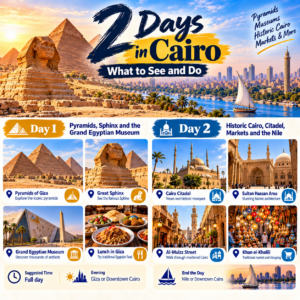
Two days in Cairo is short, but it is enough to see the city’s biggest landmarks and experience several very different sides of Egypt’s capital.
The key is not trying to see everything.
Cairo is spread across a huge metropolitan area, and traffic can easily consume hours of a short trip. Instead, this itinerary groups attractions by location: spend the first day around the Pyramids of Giza and the Grand Egyptian Museum, then dedicate the second day to Historic Cairo, the Citadel, Khan el-Khalili, and central Cairo.
This gives you a mix of ancient Egyptian history, medieval Islamic architecture, museums, markets, local food, and the Nile without turning the trip into a race.
If this is your first visit to Egypt, the itinerary below covers the attractions most likely to give you a strong first impression of Cairo while still leaving room to stop, eat, take photographs, and enjoy the city.
2 Days in Cairo at a Glance
Day 1: Pyramids of Giza → Great Sphinx → Grand Egyptian Museum → evening in Giza or Downtown
Day 2: Cairo Citadel → Sultan Hassan area → Al-Muizz Street → Khan el-Khalili → Nile or Downtown Cairo
The schedule can be adjusted depending on where you stay, your interests, and the opening hours of the attractions on your travel dates.
Day 1: Pyramids, Sphinx and the Grand Egyptian Museum
Your first day is dedicated to ancient Egypt.
This is the day when you see the monuments that have made Cairo and Giza famous around the world.
Early Morning: Start at the Pyramids of Giza
Start your first morning as early as practical.
The Pyramids of Giza are part of the UNESCO-listed Memphis and its Necropolis, an enormous archaeological property extending from Giza toward Saqqara and Dahshur.
The Giza complex includes the Great Pyramid of Khufu, the Pyramid of Khafre, the Pyramid of Menkaure, the Great Sphinx, temples, tombs, and other archaeological remains.
Do not treat the pyramids as a quick photo stop.
The scale of the plateau is difficult to appreciate from a single viewpoint. Walk around the complex and look at the pyramids from different angles.
The Great Pyramid is the obvious centerpiece, but the smaller pyramids and surrounding tombs help explain that Giza was not simply a group of three enormous monuments. It was part of a much larger funerary landscape.
How Long Should You Spend at Giza?
Allow around three hours for a relaxed visit.
You may need longer if you want to enter a pyramid, explore additional tombs, take extensive photographs, or visit the different viewpoints around the plateau.
If ancient Egyptian history is your main reason for visiting Cairo, you could easily spend most of the morning here.
Visit the Great Sphinx
After exploring the pyramids, continue toward the Great Sphinx.
The Sphinx sits near the Valley Temple and provides a different perspective on the Giza complex.
This is one of the places where it is worth slowing down for a few minutes.
Look back toward the pyramids rather than focusing only on the standard Sphinx photograph. The relationship between the monument, the temple, and the pyramids gives you a better understanding of how the complex was organized.
Late Morning: Take a Break
After several hours outdoors, take a break before moving on.
Have lunch near Giza or at a restaurant on your route toward the Grand Egyptian Museum.
This is a good opportunity to try a simple Egyptian meal.
Consider:
- Koshari
- Taameya
- Ful
- Grilled chicken or meat
- Egyptian rice
- Fresh juices
You do not need to spend a long time at lunch. The afternoon is reserved for another major attraction.
Afternoon: Grand Egyptian Museum
The Grand Egyptian Museum is located close to the Giza Plateau, making it a natural second stop on your first day.
The museum’s galleries present ancient Egyptian collections on a very large scale, and the Tutankhamun galleries bring together more than 6,000 artifacts associated with the famous king.
For a two-day trip, this is one of the easiest ways to combine the pyramids with a major museum without spending the day crossing Cairo.
Give yourself at least two to three hours.
If you are deeply interested in ancient Egyptian history, you can spend substantially longer.
Do not try to see every object.
Instead, choose a comfortable pace and focus on the collections and galleries that interest you most.
Why Visit GEM After the Pyramids?
The two attractions complement each other.
At Giza, you see the monumental architecture in its original landscape.
At GEM, you move inside and explore the objects, artistic traditions, and material culture associated with ancient Egyptian civilization.
Together, they provide a much more complete experience than visiting either one alone.
Because museum hours and visitor arrangements can change, check the official information shortly before your trip.
Late Afternoon: Return to Your Hotel
After GEM, return to your hotel and take a break.
This is important on a two-day trip.
You have already spent most of the day walking outdoors and inside a large museum. Adding another major attraction immediately afterward will probably make the evening less enjoyable.
Take a shower, rest, and go out again when you are ready.
Day 1 Evening: Choose Your Experience
You have several options for your first evening.
Option 1: Dinner with a Pyramid View
If you are staying in Giza, choose a restaurant or rooftop with a view of the pyramids.
Seeing the monuments illuminated after spending the day around them creates a very different atmosphere.
Option 2: Explore Downtown Cairo
If you are staying in central Cairo, spend the evening around Downtown.
Walk around the streets, stop at a café, and experience the city without a sightseeing checklist.
Option 3: Nile Evening
You can also finish the day beside the Nile.
A simple riverside dinner or short boat trip can be enough.
You do not need to book a large dinner cruise unless that is specifically something you want to experience.
Day 2: Historic Cairo and Khan el-Khalili
The second day moves away from the ancient Egyptian sites and into Cairo’s Islamic and medieval heritage.
This is where the character of the city changes dramatically.
Historic Cairo is a UNESCO World Heritage Site and contains an exceptional concentration of mosques, madrasas, markets, historic streets, and surviving urban neighborhoods.
Instead of jumping between unrelated attractions, keep your second day concentrated around this part of the city.
Morning: Cairo Citadel
Start your second day at the Citadel of Saladin.
The Citadel occupies an elevated position above Cairo and was an important center of government for centuries.
It is also one of the best places to understand the physical scale of the city.
From the elevated grounds, you can look across Cairo and see how densely the modern city has developed around its historic core.
Allow around one to two hours for the Citadel.
You do not need to examine every corner of the complex during a two-day visit.
Visit the Mosque of Muhammad Ali
Inside the Citadel, visit the Mosque of Muhammad Ali.
Its large domes and Ottoman-influenced design make it visually different from many of the medieval Mamluk monuments you will see later in the day.
Take a few minutes inside to appreciate the scale of the prayer hall and the architectural details.
This is also a useful contrast with the much older monuments around Al-Muizz Street.
Late Morning: Sultan Hassan and Al-Rifa’i
Continue toward the area around Sultan Hassan Mosque and Al-Rifa’i Mosque.
Sultan Hassan is one of the monumental Mamluk buildings of Cairo, while Al-Rifa’i stands opposite it.
You do not need a long visit to both.
Spend some time looking at the buildings from outside and then enter the monuments that interest you most.
For travelers interested in Islamic architecture, this area can be one of the highlights of the entire two-day itinerary.
Lunch: Eat in or Near Historic Cairo
Have lunch before continuing into the narrow streets of Historic Cairo.
This is a good time to try another Egyptian dish rather than eating at an international restaurant.
Depending on the restaurant, consider ordering:
- Molokhia
- Fattah
- Mahshi
- Grilled meat
- Grilled chicken
- Koshari
A relaxed lunch will also give you some energy before the afternoon walking route.
Afternoon: Walk Al-Muizz Street
Now move into the heart of Historic Cairo.
Al-Muizz Street is one of the city’s most important historic streets and passes through an area filled with mosques, madrasas, mausoleums, traditional buildings, shops, and workshops.
This part of Cairo is best explored slowly.
Do not create a schedule that requires you to enter every monument.
Instead, choose several buildings that interest you and spend the rest of the time walking.
Look above the shopfronts.
Some of the most interesting details are easy to miss if you are focused only on reaching the next attraction.
You will see carved stone, old wooden screens, monumental entrances, traditional markets, and layers of architecture from different periods.
Historic Cairo is valuable partly because it remains a living urban environment rather than an isolated archaeological park.
Late Afternoon: Khan el-Khalili
Continue toward Khan el-Khalili.
The famous bazaar is one of the most recognizable places in Cairo and is filled with shops selling souvenirs, crafts, jewelry, spices, lamps, leather goods, and other products.
But shopping is only part of the experience.
Walk through the narrow lanes and allow yourself to explore without a strict route.
If you see something you want to buy, compare prices before purchasing.
And if you are not interested in shopping, you can simply enjoy the atmosphere.
Stop for Egyptian Tea or Coffee
After walking around the market, sit down for a drink.
A traditional café is a useful pause after several hours of sightseeing.
Order Egyptian tea, coffee, or another local drink and simply watch the movement around the market.
This is one of those moments when doing less can make the trip feel better.
Evening: Finish Your Two Days Beside the Nile
By the second evening, you have already seen ancient Egypt and Historic Cairo.
Now finish with something more relaxed.
You can choose a restaurant overlooking the Nile, take a short boat trip, or walk along the river.
If you still have energy, continue toward Downtown Cairo or Zamalek for dinner.
The important thing is not to add another major museum or archaeological site.
Your final evening should feel like the end of the trip rather than another item on a checklist.
Should You Visit the Egyptian Museum in 2 Days?
Yes, but it depends on your priorities.
The Egyptian Museum in Tahrir houses a huge collection of ancient Egyptian antiquities, including statues, papyri, sarcophagi, jewelry, and other archaeological objects.
However, if your two-day itinerary already includes the Grand Egyptian Museum, visiting both museums can make the trip heavily museum-focused.
For a first-time visitor with only 48 hours, I would structure the trip around Giza + GEM on day one and Historic Cairo on day two.
If you are particularly interested in museums, you can replace part of day two with the Egyptian Museum.
The official museum currently lists regular visiting hours from 9 AM to 5 PM, with the ticket window closing at 4 PM. Check the current schedule before visiting because hours can change.
What About the National Museum of Egyptian Civilization?
NMEC is another excellent museum, but it is difficult to fit comfortably into a balanced two-day itinerary.
The museum presents Egyptian civilization across a much broader timeline, from prehistoric periods through the modern era, and includes the Royal Mummies Hall.
If you have a strong interest in Egyptian history, you could substitute NMEC for part of day two.
But if this is your first trip and your goal is to experience the widest range of Cairo, the Pyramids, GEM, Historic Cairo, and Khan el-Khalili give you more variety.
What If You Only Have Two Full Days?
If you have two complete days, use the itinerary exactly as outlined.
If you have only two nights but less than two full days, simplify it.
With approximately 1.5 days:
First morning: Pyramids and Sphinx
First afternoon: Grand Egyptian Museum
First evening: Dinner or Nile
Second morning: Citadel and Muhammad Ali Mosque
Second afternoon: Al-Muizz Street and Khan el-Khalili
This version removes museums and attractions that would require crossing the city.
Where to Stay for a 2-Day Cairo Trip
Where you stay matters more when you only have two days.
Giza
Giza is convenient if the pyramids are your biggest priority.
It can also reduce travel time on your first morning.
The disadvantage is that Downtown and Historic Cairo are farther away.
Downtown Cairo
Downtown provides a more central base for the Egyptian Museum, the Nile, and Historic Cairo.
It can be useful if you want to experience the city after sightseeing hours.
Zamalek
Zamalek is another practical central option.
It offers restaurants, cafés, galleries, and access to the Nile and Cairo Tower.
It can work particularly well for travelers who want evenings to be more relaxed.
The most important thing is to choose a hotel based on your itinerary rather than choosing an area only because it looks central on a map.
How to Get Around Cairo in Two Days
Do not underestimate Cairo traffic.
The most efficient strategy for a short visit is to move between major areas by car or ride-hailing service and then explore individual districts on foot.
For example:
Day 1: Giza → GEM
Day 2: Citadel → Sultan Hassan → Al-Muizz → Khan el-Khalili
This minimizes unnecessary movement.
Once you reach Historic Cairo, walking is often more useful than repeatedly getting into a car for short distances.
Leave extra time between activities if you have a fixed museum booking, airport transfer, or train departure.
What to Eat During a Short Cairo Trip
A two-day trip is not long enough to explore Cairo’s entire food scene, but you can still sample several classic dishes.
Start with ful and taameya for breakfast if you want something traditional.
Try koshari for a casual lunch.
Have molokhia, mahshi, fattah, or grilled meat for another meal.
For dessert, look for kunafa, basbousa, or umm ali.
And do not underestimate the importance of a simple Egyptian tea or coffee break.
Traveling through Cairo for two days can be physically tiring. Taking time to sit down is part of making the itinerary work.
What to Pack for 2 Days in Cairo
Keep your day bag practical.
Bring:
- Comfortable walking shoes
- Water bottle
- Sunglasses
- Sunscreen
- Portable phone charger
- Light layers
- A small amount of cash
- Tissues or hand sanitizer
If you plan to visit mosques or other religious sites, wear clothing that is respectful of the setting.
The most important item is comfortable footwear. Giza and Historic Cairo both involve substantially more walking than you might expect.
Common Mistakes to Avoid
Trying to See Everything
Two days is not enough for every museum, mosque, church, market, and archaeological site.
Choose a few major experiences and enjoy them properly.
Visiting Giza in the Middle of the Day
Starting earlier generally makes the outdoor portion of the trip more comfortable.
Crossing Cairo Repeatedly
This is one of the easiest ways to lose hours.
Group attractions by area.
Booking Too Many Museums
One major museum can take several hours.
Two or three in a single day may leave you too tired to enjoy the rest of Cairo.
Ignoring the Evening
Cairo changes after sunset.
Leave at least one evening for food, cafés, the Nile, or simply walking through the city.
Is 2 Days Enough for Cairo?
Two days is enough for a first introduction, but not enough to explore Cairo deeply.
You can experience:
- The Pyramids of Giza
- The Great Sphinx
- The Grand Egyptian Museum
- The Citadel
- The Mosque of Muhammad Ali
- Historic Cairo
- Al-Muizz Street
- Khan el-Khalili
- The Nile
What you probably cannot do comfortably is add Saqqara, NMEC, the Egyptian Museum, Coptic Cairo, Downtown, and several other neighborhoods without making the itinerary much more intense.
If ancient Egypt is your main interest, replace part of day two with Saqqara.
If Islamic architecture is your priority, spend more time around Historic Cairo.
If museums are your main reason for visiting Egypt, you may prefer the Egyptian Museum or NMEC over some of the walking portions.
The best two-day itinerary depends on what you came to Cairo to experience.
2 Days in Cairo: Quick Itinerary
| Day | Morning | Afternoon | Evening |
|---|---|---|---|
| Day 1 | Pyramids of Giza | Sphinx + Grand Egyptian Museum | Giza, Downtown or Nile |
| Day 2 | Citadel + Muhammad Ali Mosque | Al-Muizz Street + Historic Cairo | Khan el-Khalili + Nile/Downtown |
Alternative for History Lovers
If you are especially interested in museums, change the second day to:
Morning: Egyptian Museum
Afternoon: Citadel + selected Historic Cairo monuments
Evening: Khan el-Khalili
This sacrifices some walking time but gives you a stronger museum component.
Alternative for Ancient Egypt Enthusiasts
If your priority is ancient Egyptian archaeology:
Day 1: Giza + GEM
Day 2: Saqqara + Giza-area or Downtown evening
Saqqara is part of the same broader UNESCO World Heritage property as Giza and contains the Step Pyramid of Djoser, an important stage in the development of pyramid architecture.
This version makes more sense for travelers who would rather spend their two days focused almost entirely on ancient Egypt.
Final Thoughts
Two days in Cairo can be surprisingly rewarding if you resist the temptation to over-plan.
The first day introduces you to the ancient world: the Pyramids of Giza, the Great Sphinx, and the Grand Egyptian Museum.
The second day shows you a completely different Cairo: the Citadel, monumental Islamic architecture, Al-Muizz Street, Historic Cairo, and the maze of Khan el-Khalili.
Then, when the sightseeing is finished, give yourself time for Egyptian food, tea, the Nile, and ordinary city life.
You will not see everything in 48 hours.
You do not need to.
The goal is to leave Cairo having experienced several different versions of the city rather than having collected as many attraction names as possible.
Sources & References
- UNESCO World Heritage Centre — Memphis and its Necropolis
- UNESCO World Heritage Centre — Historic Cairo
- Egypt Ministry of Tourism and Antiquities — Egyptian Museum
- Egypt Ministry of Tourism and Antiquities — National Museum of Egyptian Civilization
- Experience Egypt — Grand Egyptian Museum
- Experience Egypt — Cairo & Giza