
14 Days in Egypt: The Ultimate Two-Week Itinerary
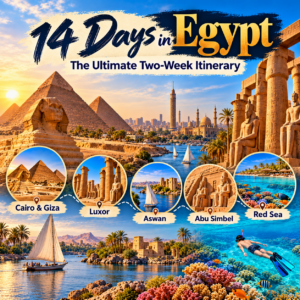
Two weeks gives you enough time to see Egypt without treating every city as a quick stop. Instead of spending the entire trip moving between airports, stations, and hotels, you can combine the country’s major ancient sites with time along the Nile and several slower days by the Red Sea.
For a first trip, a well-balanced 14-day itinerary can connect Cairo and Giza, Luxor, Aswan, Abu Simbel, and the Red Sea. This route follows the Nile south before finishing with several days on the coast, giving the trip a natural rhythm: busy cities first, concentrated sightseeing in Upper Egypt next, and relaxation at the end.
The key is not trying to see every famous place in Egypt. Cairo alone can absorb several days, while Luxor has enough archaeological sites to fill a separate trip. The Egyptian Ministry of Tourism describes Cairo and Giza, Luxor, Aswan and Abu Simbel, and the Red Sea as distinct experiences, which makes them particularly useful building blocks for a longer first visit.
Here is a practical way to spend 14 days in Egypt without making the itinerary feel like a race.
At a Glance: 14 Days in Egypt
| Days | Destination | Main Focus |
|---|---|---|
| Days 1–4 | Cairo & Giza | Pyramids, museums, Islamic Cairo and local neighborhoods |
| Days 5–7 | Luxor | Karnak, Luxor Temple, West Bank and ancient tombs |
| Days 8–9 | Aswan | Nile scenery, Philae and Nubian culture |
| Day 10 | Abu Simbel | Major temple complex and return to Aswan |
| Days 11–13 | Red Sea | Beach, snorkeling, diving and downtime |
| Day 14 | Departure | Return journey |
This is a flexible framework rather than a rigid schedule. If your flight arrives late, move some Cairo sightseeing to another day. If you care more about archaeology than beaches, you can shorten the Red Sea portion and add another historical stop.
Days 1–4: Cairo and Giza
Cairo deserves more than a single day. It is not simply a base for the pyramids; it is a huge city with medieval neighborhoods, museums, markets, modern districts and the Nile running through its center.
Four nights also give you room to recover from a long international flight before moving south.
Day 1: Arrive in Cairo
Keep your first day deliberately light.
After arriving and checking into your hotel, use the afternoon or evening to get your bearings rather than immediately scheduling a full sightseeing program.
Depending on your arrival time, take a relaxed walk around your neighborhood, have your first Egyptian meal, or spend some time near the Nile.
This is also a useful day to confirm the practical details of the rest of the trip: train or flight arrangements, hotel bookings, attraction reservations and transportation.
If you are arriving from a different time zone, resisting the temptation to fill the first evening with activities can make the following days much easier.
Where to stay in Cairo
For first-time visitors, popular bases include Downtown Cairo, Zamalek, Garden City, New Cairo and areas around Giza.
The right choice depends on what you value more: central city access, restaurants and nightlife, or proximity to the pyramids.
Day 2: Giza Pyramids and the Great Sphinx
Make your first full sightseeing day the one most visitors have been waiting for: Giza.
The Giza Plateau contains the Great Pyramid of Khufu, the pyramids of Khafre and Menkaure, and the Great Sphinx. Giza is also part of the broader Memphis and its Necropolis World Heritage area, which includes important sites such as Saqqara and Dahshur.
Start early if possible.
The pyramids are more enjoyable when you are not trying to fit them into a rushed afternoon. Give yourself time to see the major monuments, walk around the plateau and understand how the different pyramid complexes relate to one another.
The Sphinx deserves its own stop rather than being treated as a quick photo opportunity.
Should you enter a pyramid?
That depends on your interests and comfort with confined spaces.
Entering a pyramid is a different experience from viewing it from outside, but it is not essential to appreciate the Giza Plateau. If you are more interested in architecture, photography and the overall archaeological landscape, you may prefer spending the extra time exploring the plateau.
Return to Cairo after Giza and keep the evening relatively relaxed.
Day 3: Historic Cairo
Use your third day to see a very different side of the capital.
Historic Cairo offers Islamic architecture, old streets, mosques, traditional markets and centuries of urban history. Khan al-Khalili is one of the best-known areas for experiencing the atmosphere of medieval Cairo, while the Al-Muizz area provides a deeper look at historic architecture.
You do not need to rush from landmark to landmark.
Walk, stop for coffee or tea, browse the shops and leave some space for spontaneous discoveries.
This is also a good evening to try Egyptian dishes such as koshary, ful, taameya or traditional grilled foods.
Day 4: Museums and Modern Cairo
Your fourth Cairo day can be adjusted according to your interests.
Spend part of the day visiting one of the city’s major museums, then explore a modern neighborhood or return to the Nile.
If you are especially interested in ancient Egypt, use this day for more museum time.
If you have already had enough history, make it a slower city day instead.
One advantage of having four days in Cairo is that you do not have to make every morning an archaeological expedition.
Days 5–7: Luxor
After Cairo, head south to Luxor.
Luxor is often described as an open-air museum, and the description makes sense once you see how concentrated the ancient sites are around the modern city. The Nile separates the East Bank from the West Bank, with major temples and archaeological areas on both sides.
Day 5: Cairo to Luxor
Travel to Luxor in the morning or early enough to leave part of the day free.
Depending on your transportation choice and schedule, you can arrive with enough time to explore the city in the afternoon.
For your first evening, visit Luxor Temple or simply walk along the Nile.
Luxor Temple is particularly atmospheric after sunset, when the illuminated columns and statues create a completely different setting from daytime sightseeing.
Do not try to visit every major site on arrival day.
You have two full days ahead.
Day 6: Luxor’s West Bank
Start early and dedicate the morning to the West Bank.
This is where you can explore some of the most important royal and religious monuments associated with ancient Thebes, including the Valley of the Kings and the Temple of Hatshepsut at Deir al-Bahari. The official tourism authority also highlights the Valley of the Queens and the colorful tomb decorations found in the area.
The heat can become a major factor, particularly when visiting exposed archaeological sites.
An early start is therefore useful not only for avoiding crowds but also for making the sightseeing physically easier.
Spend the afternoon resting at your hotel or beside the Nile.
Day 7: Karnak and Luxor’s East Bank
Make Karnak Temple the centerpiece of your final full day in Luxor.
Karnak is not simply one temple building but a large complex of monuments, courtyards, columns and sacred spaces developed over a long period of ancient Egyptian history. Luxor Temple provides a contrasting experience closer to the modern city.
You can also use the afternoon for a museum visit or a slower walk through Luxor.
If you enjoy photography, this is a good opportunity to revisit the Nile around sunset rather than adding another major attraction.
Days 8–9: Aswan
Continue south to Aswan.
The atmosphere changes noticeably here. Official Egyptian tourism material describes Aswan as a city of Nile scenery, islands, Nubian culture and historic temples, with Philae among its major attractions.
Day 8: Luxor to Aswan
Travel from Luxor to Aswan in the morning.
The journey itself is part of the appeal because the Nile Valley remains close to the route for much of the trip.
After checking into your hotel, keep the afternoon easy.
You could take a felucca ride, explore part of the riverfront, or visit a Nubian village depending on your interests.
Aswan is one of the places where leaving empty space in the schedule can improve the trip.
Day 9: Philae and Aswan
Spend the morning exploring Philae Temple.
The temple complex is located on an island and is one of the major ancient sites associated with Aswan. The broader UNESCO-listed monuments of the area include Philae and Abu Simbel.
After sightseeing, slow down.
Visit the market, spend time along the Nile or arrange a traditional Nubian experience.
Unlike Cairo, Aswan is often better appreciated when you are not constantly moving toward the next attraction.
Day 10: Abu Simbel
Abu Simbel is one of the major reasons to extend a Nile Valley trip beyond Luxor.
The temples are associated with Ramesses II and are famous for their monumental façades and colossal seated statues. The site forms part of the UNESCO World Heritage grouping of Nubian monuments.
A day trip from Aswan is the practical choice for many travelers, although your exact transportation should be arranged according to current schedules and local conditions.
Because this is a long sightseeing day, avoid scheduling another major activity for the evening.
Return to Aswan and rest.
Is Abu Simbel worth adding to a 14-day itinerary?
For travelers particularly interested in ancient Egyptian history, it can be one of the most meaningful additions to the route.
For travelers who are already feeling exhausted by temples and archaeological sites, the Red Sea days that follow may be more valuable.
That is the central advantage of having two weeks: you can make room for both.
Days 11–13: Red Sea
After ten days of cities, temples and archaeological sites, the Red Sea gives the itinerary a completely different rhythm.
Egypt’s official tourism portal presents the Red Sea as a major destination for beaches, snorkeling, diving and marine experiences.
You have several possible bases, including Hurghada, El Gouna, Marsa Alam and Sharm El-Sheikh.
For this itinerary, choose one destination rather than trying to visit several.
Day 11: Travel to the Red Sea
Travel from Aswan to your chosen Red Sea destination.
Because this is a transition day, avoid booking an expensive excursion that depends on arriving at a precise time.
Check into your hotel, have a relaxed meal and spend the afternoon at the beach or pool.
After the intensity of Cairo and Upper Egypt, doing very little is part of the itinerary—not wasted time.
Day 12: Snorkeling, Diving or a Boat Day
Use your first full Red Sea day for the activity that matters most to you.
If you dive, book a diving excursion.
If you prefer something simpler, snorkeling or a boat trip can give you time on the water without turning the day into another sightseeing marathon.
You can also make this a pure beach day.
There is no need to fill every hour.
Day 13: A Flexible Red Sea Day
Keep the final full day flexible.
If you loved the water, book another marine activity.
If you are tired, stay at the resort, visit the beach and enjoy a long lunch.
If you want more movement, choose a locally available excursion appropriate for your destination.
The purpose of this day is to leave room for the kind of travel you discovered you wanted during the first twelve days.
Day 14: Departure
Keep your final day simple.
If your flight leaves late, have breakfast, take one last walk and leave enough time to reach the airport.
If you are flying internationally from Cairo rather than directly from the Red Sea, build a generous transfer buffer and avoid scheduling sightseeing on the same day.
For a two-week trip, it is usually better to finish with a calm departure than to turn the final morning into another race.
How to Make This 14-Day Egypt Itinerary Work
The biggest mistake with a two-week Egypt itinerary is assuming that fourteen days means fourteen full sightseeing days.
It doesn’t.
Travel days, airport transfers, hotel check-ins, meals and unexpected delays all consume time.
A better approach is to group destinations geographically.
Cairo → Luxor → Aswan → Red Sea works because you gradually move south before finishing on the coast. It avoids unnecessary backtracking and creates a natural progression from urban sightseeing to archaeology and finally relaxation.
Egypt’s official tourism material also presents the Nile Valley as a classic route connecting Cairo with Upper Egypt, while the Red Sea offers a contrasting beach and marine experience.
How Many Nights Should You Spend in Each Place?
For this itinerary:
- Cairo: 4 nights
- Luxor: 3 nights
- Aswan: 2 nights
- Red Sea: 3 nights
- Travel/transition: incorporated into the itinerary
This distribution is not mandatory.
If ancient history is your priority, move a Red Sea night to Luxor or Aswan.
If you want a holiday that combines sightseeing with relaxation, keep the three Red Sea nights.
Should You Take a Nile Cruise?
A Nile cruise can replace some of the overland travel between Luxor and Aswan.
It also changes the experience. Instead of treating the Nile as something you see between destinations, the river becomes part of the journey itself.
The official tourism portal highlights cruising and sailing as one of Egypt’s major travel experiences.
A common alternative would therefore be:
Cairo → Luxor → Nile cruise → Aswan → Red Sea
If you choose this option, adjust the number of hotel nights in Luxor and Aswan according to the cruise itinerary.
Do not book the cruise first and then try to force the rest of the trip around it. Build the overall route first.
How Much Does 14 Days in Egypt Cost?
There is no single realistic price for a two-week Egypt trip because accommodation, transportation, tours, season and travel style can change the total substantially.
A backpacker using simple hotels and public transportation will have a very different budget from a traveler using four- or five-star hotels, private guides, domestic flights and organized excursions.
Your largest costs will usually come from:
- International flights
- Hotels
- Domestic transportation
- Guided tours
- Attraction tickets
- Nile cruise, if included
- Red Sea activities
- Food and drinks
- Travel insurance
- Visa fees, if applicable
Rather than choosing a fixed daily budget before booking anything, price the major components first. Hotels and intercity transportation will give you a much clearer idea of the overall cost.
Egypt Visa and Entry Planning
Visa requirements depend on your nationality and travel circumstances.
Egypt’s official e-Visa portal states that eligible travelers can apply online, and applications should be submitted at least seven days before departure. The portal also provides the application process, including registration, completing the form, payment and downloading the approved e-Visa.
Check the official portal before your trip rather than relying on an old travel blog because entry rules can change.
What Should You Pack for Two Weeks in Egypt?
Pack for variety rather than trying to predict every situation.
For a typical Cairo–Luxor–Aswan–Red Sea itinerary, useful items include:
- Lightweight, breathable clothing
- Comfortable walking shoes
- Sun protection
- Sunglasses
- A hat
- Reusable water bottle
- Small daypack
- Swimwear
- Light layer for air-conditioned transport
- Any required medication
- Copies of important travel documents
- Portable charger
Comfortable footwear matters more than bringing a large wardrobe. Several days of archaeological sightseeing can involve substantial walking over uneven surfaces.
What About Safety?
Travel conditions can change, so check official government travel advice shortly before departure and again during your trip.
As of 23 September 2026, the UK Foreign, Commonwealth & Development Office advises against travel to North Sinai and against travel within 20 km of the Egypt–Libya border, with separate restrictions applying to some areas.
Those warnings do not mean that every destination in a typical tourist itinerary is treated identically. They do mean travelers should check the specific destination and current advice rather than assuming that conditions are the same throughout Egypt.
Travel insurance should also be checked carefully, particularly if your itinerary includes activities such as diving or excursions outside major tourist areas.
Common Mistakes on a 14-Day Egypt Trip
Trying to visit too many cities
Adding Alexandria, Siwa, the White Desert, Sharm El-Sheikh and multiple Nile stops to the same itinerary can turn two weeks into a transportation schedule.
Choose a few experiences and enjoy them properly.
Spending only one day in Cairo
The pyramids are essential for many first-time visitors, but Cairo offers much more than Giza.
Treating Luxor as a day trip
Luxor deserves multiple days because its major sites are spread across the East and West Banks.
Scheduling activities on every travel day
A transfer from one city to another already consumes energy. Leave breathing room.
Changing hotels too often
Frequent hotel changes create more logistical work without necessarily adding meaningful experiences.
Leaving no rest days
Egypt can be intense. Heat, walking, traffic and sightseeing all add up.
The Red Sea portion is valuable partly because it allows the pace to slow down.
Can You Do Egypt in 14 Days Without a Tour?
Yes, independent travel is possible, but the best approach depends on your comfort with arranging transportation, tickets and local logistics.
A hybrid approach can work particularly well.
For example, you can organize hotels and intercity transportation independently while using local guides for Giza, Luxor’s West Bank or other historically dense areas.
A knowledgeable guide can add context that is difficult to obtain by simply walking around monuments.
A More Relaxed Alternative
If this itinerary looks too busy, simplify it.
One possible adjustment is:
Cairo – 4 nights
Luxor – 3 nights
Aswan – 2 nights
Red Sea – 4 nights
You can remove Abu Simbel or treat it as optional depending on your interests.
This version gives you more downtime while still covering Egypt’s major first-time destinations.
Final 14-Day Egypt Itinerary
The strength of a two-week Egypt trip is variety.
You can begin among the pyramids and museums of Cairo, spend several days surrounded by the monuments of ancient Thebes in Luxor, slow down beside the Nile in Aswan, see Abu Simbel, and finish beside the Red Sea.
The itinerary works best when you resist the temptation to add everything.
Egypt is a large and complex destination. Fourteen days is enough to build a memorable first journey, but not enough to see the entire country.
Think of the trip as a first chapter rather than a checklist.
Frequently Asked Questions
Is 14 days enough for Egypt?
Yes. Fourteen days gives first-time travelers enough time to combine Cairo, Luxor, Aswan and a Red Sea destination without making every day a sightseeing marathon.
Should I visit Cairo or Luxor first?
For most international arrivals, Cairo is the natural starting point because it provides an introduction to Egypt’s modern city life and Giza’s ancient monuments before continuing south.
How many days should I spend in Luxor?
Three nights works well for a first visit if you want time for both the East Bank and West Bank without rushing.
Is Abu Simbel worth visiting?
It is particularly worthwhile for travelers interested in ancient Egyptian history. It requires additional travel from Aswan, so consider your energy level and priorities.
Should I include the Red Sea?
If you want a balance between sightseeing and relaxation, three or four nights on the Red Sea can give the itinerary a useful change of pace.
Can I take a Nile cruise during these two weeks?
Yes. A Nile cruise can be incorporated between Luxor and Aswan, but you should adjust the land itinerary around the cruise dates rather than adding it on top of the existing schedule.