
Egypt Itinerary for First-Time Visitors
Planning your first trip to Egypt can be surprisingly difficult.
The problem is not a lack of places to visit. It is the opposite. Cairo, Giza, Luxor, Aswan, Abu Simbel, the Red Sea, Alexandria and the desert all offer completely different experiences, and trying to fit too many of them into one trip can leave you spending more time in transit than actually enjoying Egypt.
For most first-time visitors, the most practical route follows the Nile south: Cairo and Giza → Luxor → Aswan → Red Sea. This gives you the pyramids and museums, the major temples and tombs of ancient Egypt, the landscapes of the Nile Valley, and several days to relax by the sea.
Egypt’s official tourism information similarly presents the Nile Valley as a classic travel route, with Cairo, Upper Egypt, Luxor and Aswan forming the core of a traditional first visit.
The number of days you have will determine how much of this route makes sense. A week requires careful choices, while 10–14 days gives you enough room to slow down and add destinations without turning the trip into a checklist.
Here is how to plan it.
The Best Egypt Itinerary for First-Time Visitors
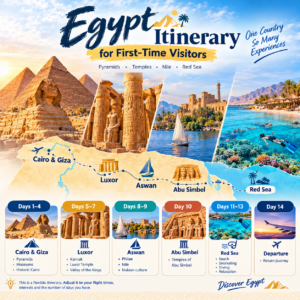
For a first trip of around two weeks, a practical outline is:
| Days | Destination | Main Experiences |
|---|---|---|
| Days 1–4 | Cairo & Giza | Pyramids, museums, Historic Cairo |
| Days 5–7 | Luxor | Karnak, Luxor Temple, Valley of the Kings |
| Days 8–9 | Aswan | Philae, Nile, Nubian culture |
| Day 10 | Abu Simbel | Temples of Abu Simbel |
| Days 11–13 | Red Sea | Beach, snorkeling, diving and relaxation |
| Day 14 | Departure | Return journey |
You do not have to follow this exact schedule.
If you have only seven days, remove the Red Sea or Abu Simbel and concentrate on Cairo, Luxor and Aswan. If you have three weeks, you can consider adding Alexandria, Siwa or more time along the Red Sea.
The important thing is to avoid moving between destinations simply because they appear on a list of “must-see” attractions.
Days 1–4: Cairo and Giza
Cairo should normally be the starting point for a first trip to Egypt.
It combines modern city life with historic neighborhoods, museums, Islamic and Coptic heritage, and easy access to Giza. The official tourism authority describes Greater Cairo as the country’s major metropolitan center, extending across Cairo and Giza along the Nile.
Four days may sound like a lot when your main goal is to see the pyramids, but Giza is only one part of the Cairo experience.
Day 1: Arrive in Cairo
Do not plan an ambitious sightseeing schedule for your arrival day.
After checking into your hotel, use the remaining time to settle in, exchange or withdraw some local currency if needed, and get familiar with the area around your accommodation.
If you arrive early, you could have dinner overlooking the Nile or take a relaxed evening walk.
If your flight arrives late, simply sleep.
The first day should make the next morning easier, not harder.
Where should first-time visitors stay in Cairo?
There is no single neighborhood that works for every traveler.
Downtown Cairo is convenient for central city sightseeing and restaurants.
Zamalek offers a more relaxed island setting with cafés, restaurants and hotels.
Giza puts you closer to the pyramids and can be convenient if seeing the monuments early is a priority.
The best choice depends on whether your trip is primarily about ancient sites, city life or convenience.
Day 2: Giza Pyramids and the Sphinx
Make the Giza Plateau one of your first full sightseeing days.
The plateau contains the Great Pyramid of Khufu, the pyramids of Khafre and Menkaure, the Great Sphinx and a much larger archaeological landscape than many visitors expect. The wider Memphis and its Necropolis World Heritage area also includes important sites such as Saqqara and Dahshur.
Start early if you can.
The site is large, and the combination of walking, sun and crowds can make a late start tiring.
Do not rush through the pyramids simply to get to the next attraction. Give yourself time to walk around the plateau and understand the scale of the monuments.
You can spend most of the day around Giza and return to your hotel in the afternoon.
If you still have energy, use the evening for dinner or a relaxed Nile-side outing.
Day 3: Egyptian History and Cairo
Use the third day for a museum and a different side of Cairo.
This is a good opportunity to spend several hours with ancient Egyptian artifacts before exploring another part of the city.
After the museum, consider visiting Historic Cairo.
The official tourism authority highlights the city’s Islamic and Coptic heritage, medieval streets, Khan al-Khalili and other historic areas as major parts of the Cairo experience.
You do not need to see every mosque, church and historic building.
Choose a small area and explore it slowly.
Khan al-Khalili is particularly useful for experiencing the atmosphere of the old city, but it is better approached as a neighborhood to wander through rather than an attraction to “complete.”
Day 4: Saqqara, Dahshur or More Cairo
Your fourth Cairo day should depend on your interests.
If ancient Egyptian architecture is your main reason for visiting, consider a trip to Saqqara and Dahshur.
Saqqara contains the Step Pyramid of Djoser, while Dahshur provides an important look at the development of pyramid construction before the famous monuments at Giza.
If you have already had enough archaeological sites, stay in Cairo instead.
Explore a neighborhood, visit another museum, spend time beside the Nile or simply have a slower day.
This flexibility is one reason to spend four nights in the capital.
Days 5–7: Luxor
After Cairo, travel south to Luxor.
The change is dramatic.
Cairo is a huge modern metropolis. Luxor is much more concentrated around the remains of ancient Thebes, with the Nile separating the East Bank from the West Bank.
The official tourism authority describes Luxor as an “open-air museum,” with Karnak and Luxor temples on the East Bank and major tombs and monuments on the West Bank.
Day 5: Cairo to Luxor
Travel to Luxor and check into your hotel.
Do not schedule a full day of sightseeing around your arrival.
If you arrive early enough, use the afternoon to explore the waterfront or visit Luxor Temple.
Luxor Temple is especially interesting because it sits close to the modern city, making it easy to combine with an evening walk.
Another option is simply to watch the sunset over the Nile.
After two busy days in Cairo, a slower afternoon can make the rest of your Luxor stay much more enjoyable.
Day 6: Valley of the Kings and the West Bank
Start early and concentrate on Luxor’s West Bank.
This is where you will find some of the most important royal tombs and monuments associated with ancient Thebes, including the Valley of the Kings and Temple of Hatshepsut at Deir al-Bahari.
The Valley of the Queens is another important area, while the decorated tomb interiors provide a very different experience from the monumental temples.
This is one of the days when having a knowledgeable guide can make a significant difference because the historical context is as important as the structures themselves.
Return to your hotel during the hotter part of the afternoon if possible.
Day 7: Karnak and Luxor’s East Bank
Use your final full Luxor day for the East Bank.
Start with Karnak Temple, one of the largest and most important temple complexes in ancient Egypt.
Then visit Luxor Temple if you did not see it on your arrival day.
You can leave the afternoon open for the Luxor Museum, a Nile walk or simply some rest.
Do not feel obligated to add another major archaeological site.
After several days of temples and tombs, a quiet evening beside the Nile can be more enjoyable than another packed excursion.
Days 8–9: Aswan
Continue south to Aswan.
The scenery becomes an important part of the experience here. The Nile, islands, desert landscape and Nubian communities give Aswan a different atmosphere from Cairo and Luxor.
Official Egyptian tourism information highlights Philae, Nubian culture, the Nile and the area’s islands among the main reasons to visit.
Day 8: Luxor to Aswan
Travel to Aswan and check into your hotel.
Keep the afternoon flexible.
You might take a felucca ride, walk along the Nile or explore part of the city.
If you are interested in Nubian culture, this is also a good place to arrange a local experience.
Aswan is a destination where slowing down makes sense.
You do not need to fill every hour.
Day 9: Philae and Aswan
Spend part of the day visiting Philae Temple.
The temple is associated with the island of Philae and forms part of the UNESCO-listed Nubian monuments alongside other important sites in the region.
Afterward, leave time for the city itself.
Visit a local market, spend time near the river or explore the botanical garden if that interests you.
This is also a good evening to have an unplanned dinner and enjoy the Nile without another major attraction on the schedule.
Day 10: Abu Simbel
If ancient Egyptian history is one of your main reasons for visiting Egypt, consider dedicating Day 10 to Abu Simbel.
The monumental temples were built under Ramesses II and are famous for the four colossal seated statues on the main façade. Abu Simbel forms part of the UNESCO World Heritage grouping of Nubian monuments.
Most travelers visiting from Aswan arrange this as a day trip.
Because the journey takes time, treat it as your major activity for the day rather than trying to combine it with another large excursion.
Return to Aswan and rest.
Can you skip Abu Simbel?
Yes.
If your priority is relaxation, beaches or spending more time in Cairo and Luxor, Abu Simbel can be removed.
If ancient Egyptian monuments are the main reason you came to Egypt, it is a destination worth considering.
Days 11–13: Red Sea
After Cairo, Luxor and Aswan, the Red Sea provides a completely different experience.
Egypt’s official tourism portal identifies the Red Sea as one of the country’s major destination areas, with beaches, diving, snorkeling and marine activities.
Choose one base rather than trying to visit several Red Sea resorts during the same short trip.
Depending on your itinerary, options include Hurghada, Marsa Alam or Sharm El-Sheikh.
Day 11: Travel to the Red Sea
Make this primarily a travel and arrival day.
Check into your hotel, have lunch or dinner and spend the rest of the afternoon at the beach or pool.
You have already spent more than a week sightseeing.
There is no reason to turn every remaining day into another archaeological tour.
Day 12: Beach, Diving or Snorkeling
Choose one main activity.
If you are a diver, arrange a diving trip.
If you prefer something more casual, go snorkeling or take a boat trip.
Or do nothing more ambitious than swim, read and enjoy the beach.
The right choice depends on what you want the final part of your Egypt trip to feel like.
Day 13: Keep It Flexible
Make your final full day intentionally flexible.
You could repeat an activity you enjoyed, spend the day at the resort or book a short local excursion.
Avoid scheduling something that creates a complicated transfer before your international flight.
The goal is to finish the trip feeling rested rather than trying to squeeze in one final attraction.
Day 14: Departure
Your departure plan depends on where your international flight leaves from.
If you are flying directly from a Red Sea airport, keep the morning simple.
If you need to return to Cairo for your international flight, allow plenty of time for the transfer.
Do not assume that a same-day connection will be comfortable simply because the distances look manageable on a map.
A little extra buffer is particularly useful at the end of a two-week trip.
How Many Days Do You Need in Egypt?
There is no single answer because the ideal length depends on what you want to see.
5–7 days
Focus on:
Cairo + Giza + Luxor
This gives you a strong introduction without attempting to cover the entire country.
8–10 days
Consider:
Cairo + Giza + Luxor + Aswan
You can add Abu Simbel if your schedule allows.
12–14 days
You can comfortably consider:
Cairo + Giza + Luxor + Aswan + Abu Simbel + Red Sea
This is the most balanced option for travelers who want ancient history and some time to relax.
2–3 weeks
You have enough time to consider adding destinations such as Alexandria, Siwa or additional Red Sea days.
Egypt’s official tourism map also presents Mediterranean Egypt, desert oases and Red Sea destinations as alternatives to the classic Nile Valley route.
Should First-Time Visitors Take a Nile Cruise?
A Nile cruise is one of the main alternatives to traveling independently between Luxor and Aswan.
Instead of treating the Nile as scenery between cities, the river becomes part of the journey.
A typical route can connect Luxor and Aswan while allowing passengers to visit several ancient sites along the way.
For travelers who want a slower, more organized experience, a cruise can also reduce the number of individual transportation arrangements.
The trade-off is flexibility.
If you prefer choosing exactly when you leave each city and how long you stay, independent travel may suit you better.
How to Get Around Egypt
There is no single transportation method that works for the whole itinerary.
For a first visit, think about transportation by segment.
Cairo → Luxor: train or flight, depending on your schedule and preference.
Luxor → Aswan: train, private transfer or Nile cruise.
Aswan → Abu Simbel: organized excursion or other arranged transport.
Aswan → Red Sea: depends heavily on the destination and current transport options.
You do not need to book every transfer months in advance, but major segments should be planned before you arrive.
Train or Flight Between Cairo and Luxor?
A flight is faster.
A train can be more convenient for travelers who prefer overland travel and want to avoid another airport journey.
The choice comes down to your priorities: time, comfort, budget and schedule.
Do not choose solely based on travel duration. Airport transfers and check-in time can make a short flight less time-saving than it appears.
When Is the Best Time to Visit Egypt?
Egypt can be visited throughout much of the year, but temperatures vary significantly by season and region.
For first-time visitors planning extensive sightseeing in Cairo and Upper Egypt, weather should be one of the factors considered before choosing dates.
Luxor and Aswan can become particularly hot, making early starts useful during warmer periods.
The Red Sea has a different climate and can be approached more as a beach destination.
Rather than choosing dates solely around the weather, consider the combination of temperature, crowds, accommodation prices and the type of activities you want to do.
Egypt Visa and Entry Requirements
Visa requirements depend on your nationality.
Egypt’s official e-Visa portal provides online applications for eligible nationalities. The current portal says applicants should create an e-Visa application at least seven days before departure.
The official portal also states that applicants need a passport valid for at least six months from arrival and may need to present a printed e-Visa, travel itinerary and accommodation details. Requirements can vary, so check the official portal for your nationality before traveling.
What Should You Pack for Your First Egypt Trip?
You do not need an enormous suitcase.
Focus on practical items:
- Comfortable walking shoes
- Lightweight clothing
- Sun protection
- Hat and sunglasses
- Reusable water bottle
- Small daypack
- Swimwear if visiting the Red Sea
- Light layer for air-conditioned transport
- Portable charger
- Copies of important travel documents
Comfortable shoes are particularly important because the itinerary includes archaeological sites where you may spend hours walking.
A small daypack is also useful for carrying water, sunscreen and other essentials during sightseeing.
How Much Does a First Trip to Egypt Cost?
The total cost depends heavily on your travel style.
The biggest variables are usually:
- International flights
- Hotel category
- Domestic transportation
- Private guides
- Attraction tickets
- Nile cruise
- Red Sea activities
- Food
- Visa fees
- Travel insurance
Instead of using one generic daily budget, calculate your trip in sections.
Start with flights and accommodation.
Then add intercity transportation and major tours.
Finally estimate meals, entrance fees and activities.
This produces a much more useful budget than simply multiplying an average “daily Egypt cost” by the number of days.
Is Egypt Suitable for Independent First-Time Travelers?
It can be, but your experience will depend heavily on how comfortable you are with transportation, negotiation, navigating busy cities and organizing sightseeing.
A hybrid approach is often practical.
You can arrange hotels and major transportation yourself while hiring local guides for places where historical context matters, particularly Giza and Luxor.
You also do not need to organize every hour before leaving home.
A useful strategy is to book the major pieces first and leave smaller activities flexible.
Important Travel Advice for First-Time Visitors
Travel conditions can change, so check official government advice before departure and during your trip.
As of 23 September 2026, the UK’s FCDO advises against all travel to North Sinai and to areas within 20 km of the Egypt–Libya border, with additional restrictions for certain regions. Its regional guidance also treats several major tourist destinations differently from restricted areas, including Luxor, Aswan and Abu Simbel.
This is why travelers should check the specific destination rather than treating “Egypt” as one uniform travel zone.
If your itinerary includes desert excursions or areas away from established tourist routes, check current requirements and use authorized operators where required.
Mistakes First-Time Visitors Should Avoid
Trying to See Everything
Egypt is too large and diverse for a short trip to cover everything.
A focused itinerary is more enjoyable than constantly changing hotels.
Spending Only One Day in Cairo
Giza is essential for many visitors, but Cairo itself has enough history and culture to justify several days.
Treating Luxor as a Quick Stop
The East Bank and West Bank deserve time.
Forgetting Travel Time
A destination may look close on a map while the actual journey takes much longer.
Always think about the entire door-to-door journey.
Booking Too Many Tours
You do not need a guided excursion every morning.
Leave room for independent exploration and rest.
Ignoring the Heat
Start early when temperatures are high and avoid assuming you can comfortably spend an entire day outdoors.
Changing Hotels Every Night
Frequent hotel changes create packing, check-in and transportation work without necessarily adding another meaningful experience.
A Simpler 10-Day Egypt Itinerary
If you only have ten days, simplify rather than rushing.
Days 1–3: Cairo and Giza
Days 4–6: Luxor
Days 7–8: Aswan
Day 9: Abu Simbel or extra Aswan time
Day 10: Return/departure
If you want the Red Sea more than Abu Simbel, replace the final archaeological day or reduce the Cairo stay.
A Relaxed 14-Day Egypt Itinerary
For travelers with two full weeks, this version provides a better balance between sightseeing and downtime:
Days 1–4: Cairo and Giza
Days 5–7: Luxor
Days 8–9: Aswan
Day 10: Abu Simbel
Days 11–13: Red Sea
Day 14: Departure
The advantage is that each destination has a clear purpose.
Cairo introduces you to Egypt’s modern and ancient capital region.
Luxor concentrates the major archaeological experience.
Aswan slows the pace and introduces a different Nile landscape.
Abu Simbel provides one major final historical excursion.
The Red Sea finishes the journey with time away from temples, museums and city traffic.
Final Thoughts
The best first-time Egypt itinerary is not the one with the longest list of attractions.
It is the one that gives you enough time to understand the places you visit.
For most travelers, that means starting in Cairo and Giza, continuing south to Luxor, slowing down in Aswan, considering Abu Simbel, and ending with several days on the Red Sea.
If you have only a week, reduce the number of destinations.
If you have two weeks, resist the temptation to add too many more.
Egypt is a country where the spaces between the famous sights can be part of the experience: a felucca moving across the Nile, an evening walk through an old Cairo neighborhood, sunset over Luxor or a quiet morning beside the Red Sea.
Build the itinerary around those moments as well as the monuments, and the trip becomes more than a checklist of famous places.
Frequently Asked Questions
How many days are enough for a first trip to Egypt?
Seven days can cover the essentials, but 10–14 days allows you to combine Cairo, Luxor and Aswan with either Abu Simbel or the Red Sea without rushing as much.
What should I see first in Egypt?
Cairo and Giza are a natural starting point for many international visitors. Giza provides the famous pyramids, while Cairo adds museums, historic neighborhoods and modern city life.
How many days should I spend in Luxor?
Two to three full days work well for a first visit, particularly if you want to explore both the East and West Banks.
Should I visit Aswan or Luxor?
They offer different experiences. Luxor is particularly focused on temples, tombs and ancient Thebes, while Aswan combines Nile scenery, islands, Nubian culture and access to Philae and Abu Simbel.
Should I include the Red Sea?
If you have 10–14 days and want time for relaxation, the Red Sea can provide a useful contrast to the archaeological-heavy part of the itinerary.
Can I travel around Egypt without a tour?
Yes, although many first-time visitors choose a combination of independent travel and locally arranged guides or excursions.