
10 Days in Egypt: Cairo, Luxor, Aswan and the Red Sea
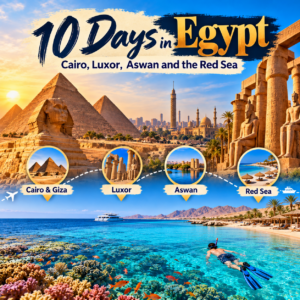
Ten days gives you enough time to see several sides of Egypt without turning the entire trip into a race between airports, train stations and hotel check-ins.
For a first visit, one practical route is to begin in Cairo and Giza, travel south to Luxor, continue to Aswan, and finish with several slower days on the Red Sea.
The route works because each stop adds something different. Cairo combines modern city life with historic neighborhoods and access to the pyramids. Luxor concentrates some of Egypt’s most important temples and tombs. Aswan brings a slower Nile-side atmosphere, Philae and access to Abu Simbel. The Red Sea then gives you time to step away from archaeological sightseeing and spend a few days by the water. Egypt’s official tourism authority presents these destinations as distinct parts of the country’s Nile and Red Sea travel regions.
The exact order can change depending on your international flights and domestic transportation, but the itinerary below provides a practical framework for a first-time traveler.
Your 10-Day Egypt Itinerary at a Glance
| Day | Destination | Main focus |
|---|---|---|
| Day 1 | Cairo | Arrival and easy introduction to the city |
| Day 2 | Cairo & Giza | Pyramids, Sphinx and Cairo |
| Day 3 | Cairo | Historic Cairo and museums |
| Day 4 | Cairo → Luxor | Travel south and explore Luxor |
| Day 5 | Luxor | West Bank and Karnak |
| Day 6 | Luxor → Aswan | Nile journey and southern Egypt |
| Day 7 | Aswan | Philae and Nile |
| Day 8 | Aswan → Red Sea | Travel to the coast |
| Day 9 | Red Sea | Beach, snorkeling or diving |
| Day 10 | Red Sea | Relaxation and departure |
This itinerary assumes that you can arrange your international departure from the Red Sea region or have enough time to return to Cairo before your flight.
If your international ticket requires you to return to Cairo, keep the final transportation connection in mind when booking the trip.
Days 1–3: Start in Cairo and Giza
Cairo deserves more than a quick overnight stop.
The official Egyptian tourism authority describes Cairo and Giza as a combination of ancient monuments, historic neighborhoods, Downtown Cairo and contemporary city life. Giza, across the Nile from central Cairo, contains the famous pyramid complex and forms part of the UNESCO-listed Memphis and its Necropolis.
Day 1: Arrive in Cairo
Keep your first day deliberately light.
After an international flight, immigration, baggage collection and transportation to your hotel, you may not have much energy left for major sightseeing.
If you arrive early enough, use the afternoon or evening for a simple introduction to Cairo.
You could:
- Walk along the Nile
- Have dinner near your hotel
- Visit a nearby café
- Explore your neighborhood
- Take an evening felucca ride if conditions and timing allow
Do not feel that you are wasting the day by taking it slowly. You have two full sightseeing days ahead.
Where to Stay in Cairo
For a first visit, location matters more than choosing a hotel simply because it has the lowest price.
Downtown, Zamalek, Garden City and Giza offer very different experiences and travel times.
If the pyramids are your main priority, Giza can be convenient. If you want to spend more time exploring central Cairo, staying closer to the city center may make more sense.
Day 2: Giza Pyramids and the Ancient Wonders
Make the Giza Plateau the focus of your second day.
The Giza complex includes the Great Pyramid of Khufu, the pyramids of Khafre and Menkaure, the Sphinx and other monuments. The wider Memphis and its Necropolis World Heritage Site also includes important archaeological areas such as Saqqara and Dahshur.
Morning: Giza Plateau
Start early if possible.
You will have more time to explore before the heat becomes a major factor, particularly during the warmer months.
Give the plateau several hours rather than treating it as a quick photo stop.
If you want to enter one of the pyramids, check the current ticketing arrangements before your visit.
Afternoon: Saqqara or Cairo
After Giza, you have two reasonable choices.
If ancient Egyptian history is your main interest, continue toward Saqqara. The official tourism authority identifies Saqqara as part of the Memphis and its Necropolis World Heritage Site and notes the Step Pyramid of Djoser among its major monuments.
If you are already tired, return to Cairo and spend the afternoon more slowly.
You do not need to turn every day into an archaeological marathon.
Evening
Have dinner in Cairo and keep the evening relatively relaxed.
Tomorrow is another full day.
Day 3: Discover a Different Side of Cairo
Your third day is an opportunity to see Cairo beyond the pyramids.
You could focus on Historic Cairo, museums or central neighborhoods.
The official tourism authority highlights Historic Cairo’s Islamic and Coptic heritage alongside Downtown Cairo and its modern neighborhoods.
Option 1: Historic Cairo
Explore historic streets, mosques and traditional markets.
This gives you a very different experience from the open archaeological landscape around Giza.
Option 2: Museums
If museums are important to you, dedicate a substantial part of the day to one rather than trying to visit several museums quickly.
Option 3: Cairo at a Slower Pace
You can also simply explore neighborhoods, eat local food and spend time along the Nile.
This is particularly useful if the first two days have been physically demanding.
Day 4: Cairo to Luxor
Day four takes you south toward Luxor.
There are several ways to make the journey, including domestic flights and trains. Egypt’s official tourism information identifies both as important options for moving between major destinations.
For a 10-day trip, preserving sightseeing time matters.
Flying to Luxor
A domestic flight can significantly reduce the amount of time spent traveling.
This can be useful if you want to maximize your time in Luxor and Aswan.
Traveling by Train
The train gives you an overland alternative and follows the Nile Valley route.
Check current schedules and booking arrangements before your trip rather than relying on old timetable information.
Afternoon in Luxor
Once you arrive and check in, avoid filling the rest of the day with several major attractions.
A good option is Luxor Temple.
The temple is on the East Bank and can provide an introduction to the monumental scale of ancient Thebes before your full sightseeing day tomorrow. The official tourism authority identifies Luxor Temple and Karnak among the city’s principal East Bank attractions.
If you arrive late, simply have dinner and rest.
Day 5: Luxor’s Temples and Tombs
This is one of the most important days of the itinerary.
Ancient Thebes, modern Luxor, is a UNESCO World Heritage area containing major monuments on both sides of the Nile. These include Karnak and Luxor Temple on the East Bank and the Valley of the Kings, Valley of the Queens and Temple of Hatshepsut on the West Bank.
Morning: West Bank
Start with the West Bank.
Depending on your interests and available time, consider:
- Valley of the Kings
- Temple of Hatshepsut
- Colossi of Memnon
- Additional tombs or archaeological sites
The Valley of the Kings is particularly important for travelers interested in royal tombs and ancient Egyptian burial practices.
You do not need to visit every available tomb.
Choose several that interest you and allow enough time to appreciate them.
Afternoon: Karnak Temple
After lunch and a break, visit Karnak.
The complex is one of Luxor’s defining archaeological sites and is described by Egypt’s tourism authority as one of the city’s major ancient monuments.
Its size makes it worth approaching as a substantial visit rather than a quick stop.
Evening: Nile-Side Dinner
After a long day, slow down.
A Nile-side restaurant or quiet evening around your hotel can be more enjoyable than adding another major attraction.
Day 6: Luxor to Aswan
Today you continue south.
The journey between Luxor and Aswan can be made by train, road transportation or a Nile cruise depending on your itinerary.
Egypt’s official tourism authority specifically promotes Nile cruising as a way to explore the archaeological sites between Luxor and Aswan.
Option 1: Direct Transportation
If time is the priority, travel directly to Aswan.
Once you arrive, check in and use the remaining time to explore the riverfront.
Option 2: Nile Cruise
If the cruise experience is important to you, this section of the trip can become part of the holiday itself.
A Nile cruise allows you to experience the river while visiting archaeological sites along the route. Official tourism information also highlights dahabeyas as a more intimate form of Nile travel.
A full cruise may require adjusting the itinerary, so check the actual sailing dates and duration before building the rest of the trip around it.
Day 7: Explore Aswan
Aswan changes the pace of the trip.
The official tourism authority describes Aswan as a place of islands, Nile scenery, Nubian culture and major attractions including Philae Temple.
Morning: Philae Temple
Make Philae one of the day’s main activities.
The temple is part of the UNESCO-listed Nubian Monuments from Abu Simbel to Philae and is located south of Aswan.
Allow time for the transportation involved in reaching the island.
Afternoon: Aswan and Nubian Culture
Use the afternoon for something less demanding.
Options include:
- Exploring Aswan’s markets
- Spending time beside the Nile
- Visiting a Nubian village with a reputable operator
- Taking a traditional boat trip
- Relaxing at your hotel
You have already spent several days visiting major archaeological sites. This is a good place to slow the rhythm.
What About Abu Simbel?
Abu Simbel is one of the major attractions of southern Egypt.
The official tourism authority describes the colossal temples of Abu Simbel as part of the Nubian Monuments World Heritage Site and highlights the four monumental seated statues of Ramesses II.
If Abu Simbel is one of your highest priorities, you can dedicate part of Day 7 to the excursion.
But do not add it automatically.
A 10-day itinerary already contains several major transfers, and the excursion needs to fit with your Red Sea transportation on the following day.
If necessary, reduce other Aswan activities rather than trying to fit everything into one schedule.
Day 8: Aswan to the Red Sea
Day eight changes the character of your holiday again.
After several days focused on archaeology and the Nile, the Red Sea provides time for beaches, marine activities and relaxation.
Egypt’s official tourism authority presents the Red Sea as a major travel region and highlights activities such as diving, snorkeling, fishing, boat trips and coastal relaxation.
Which Red Sea Destination Should You Choose?
The right destination depends on the type of coastal experience you want.
Hurghada can work well for travelers who want a large resort base and easy access to marine activities.
Marsa Alam may appeal to travelers who want a more nature-oriented Red Sea experience and access to diving and snorkeling.
Sharm El Sheikh is another major resort destination, particularly for travelers interested in beaches, diving and a wide selection of tourist facilities.
For a 10-day itinerary, choose one Red Sea base.
Trying to visit multiple coastal destinations will add unnecessary transportation.
Getting There
The exact transportation choice depends on your hotel, departure airport and available services.
Check current domestic flight and road options before booking because schedules can change.
Day 9: A Full Red Sea Day
This is your least structured day.
That is intentional.
After Cairo, Giza, Luxor and Aswan, you do not need another checklist.
Choose one main activity.
Option 1: Snorkeling
A boat excursion can provide access to Red Sea reefs and marine environments.
Option 2: Diving
If you are a certified diver, the Red Sea is one of the reasons many travelers extend an Egypt itinerary to the coast.
Option 3: Beach and Resort Day
You can also do nothing ambitious.
Spend the day swimming, relaxing and enjoying your hotel.
Option 4: Boat Trip
The official tourism authority specifically promotes Red Sea boat trips for diving, snorkeling, fishing or simply enjoying the sea.
Choose activities through reputable operators and confirm what is included before booking.
Day 10: Red Sea and Departure
Your final day depends entirely on your international flight.
If your flight leaves from a Red Sea airport, keep the morning flexible and arrange your transfer in advance.
If your international flight leaves from Cairo, do not underestimate the distance and transportation time involved.
In that case, consider returning to Cairo on Day 9 and spending the final night near your departure airport.
This may feel less exciting than staying at the beach until the last minute, but it reduces the risk of making an international departure depend on a same-day domestic transfer.
Why This 10-Day Route Works
The itinerary has a deliberate rhythm:
Cairo and Giza → ancient history → Nile Valley → Aswan → Red Sea
The first part of the trip is relatively intense.
You are exploring major cities, pyramids, museums, temples and tombs.
The final part slows down.
That contrast matters.
Trying to maintain the same sightseeing pace for all ten days can make the trip exhausting. The Red Sea section gives you time to relax after the archaeological portion.
Should You Spend More Time in Cairo or Luxor?
If you are choosing between additional time in Cairo and additional time in Luxor, think about your interests.
Choose more Cairo time if you want:
- Museums
- Historic neighborhoods
- Markets
- Restaurants
- Modern Egyptian city life
- More time around Giza and Saqqara
Choose more Luxor time if you want:
- Temples
- Tombs
- Archaeological sites
- Ancient Egyptian history
- More time exploring the East and West Banks
Both destinations serve different purposes, so the decision should be based on what you want to experience.
How Much Time Should You Spend at the Red Sea?
For a 10-day trip, two to three nights gives you enough time to change the rhythm of the vacation without taking over the entire itinerary.
One night can feel too short after a long transfer.
Four or five nights can work if the beach is one of your main reasons for visiting Egypt, but you would need to reduce the time allocated to Cairo or southern Egypt.
A simple rule is:
- History-focused trip: 1–2 nights
- Balanced trip: 2–3 nights
- Beach-focused trip: 4+ nights
What Should You Book Before Leaving Home?
For this itinerary, several parts are worth organizing before departure.
First: Check Entry Requirements
Visa requirements depend on nationality.
Egypt’s official e-Visa portal says eligible travelers should create an e-Visa application at least seven days before departure. It also provides the official application and payment process.
Second: Book International Flights
Try to make your arrival and departure airports work with your route.
A multi-city ticket can sometimes make an itinerary easier if available for your origin and travel dates.
Third: Arrange Major Domestic Transportation
Decide how you will travel:
- Cairo → Luxor
- Luxor → Aswan
- Aswan → Red Sea
- Red Sea → departure airport or Cairo
Fourth: Book Accommodation
Book hotels only after the route is fixed.
Fifth: Reserve High-Priority Activities
If you definitely want a Nile cruise, diving excursion or Abu Simbel trip, check availability before your travel dates.
What Should You Pack for This Trip?
A 10-day Egypt trip combines city sightseeing, archaeological sites and the coast, so pack for several situations.
Bring:
- Comfortable walking shoes
- Lightweight clothing
- Sun protection
- Sunglasses
- Hat
- Reusable water bottle
- Light layer for cooler evenings
- Scarf or cover-up for religious sites
- Swimwear
- Travel adapter
- Copies of travel documents
The official Egyptian tourism authority recommends lightweight clothing, sun protection and comfortable shoes and notes that visitors may need clothing that covers their arms and legs when visiting religious sites.
How Much Does 10 Days in Egypt Cost?
There is no single useful price for this itinerary because your total cost can change significantly depending on your travel style.
The biggest variables are:
| Expense | What changes the cost |
|---|---|
| International flights | Origin, dates and airline |
| Hotels | Location, season and hotel category |
| Domestic transportation | Flights, trains, private transfers |
| Nile cruise | Cruise category and duration |
| Attractions | Entry fees and optional experiences |
| Guides | Private or group tours |
| Red Sea | Resort level and activities |
| Food | Local restaurants versus hotel dining |
| Diving/snorkeling | Equipment, boat trips and operator |
The route itself can affect the budget.
A traveler who flies between distant cities and books private transfers will have a very different transportation budget from someone who uses trains and shared services.
For accurate current prices, check the relevant provider when booking rather than relying on an old article.
Travel Advice for This Route
Travel advice should be checked shortly before departure because regional conditions can change.
As of September 23, 2026, the UK’s Foreign, Commonwealth & Development Office advises against all travel to North Sinai and within 20 km of the Egypt-Libya border, among other region-specific restrictions. Its current regional guidance specifically lists Luxor, Aswan and Abu Simbel among exceptions to its broader Western Desert advisory, and says travel to southern Red Sea tourist areas such as Sharm El Sheikh, Hurghada and Marsa Alam is generally low risk.
These recommendations are geographically specific and should not be interpreted as applying uniformly across Egypt.
Travelers should check the latest advice issued by their own government and ensure that their travel insurance covers their itinerary.
The FCDO also advises travelers to remain aware of their surroundings and follow local authorities’ guidance.
Common Mistakes on a 10-Day Egypt Trip
Trying to Visit Two Red Sea Resorts
Pick one.
You already have four major regions in the itinerary.
Adding Alexandria
Alexandria is an interesting destination, but adding it to Cairo, Luxor, Aswan and the Red Sea creates another geographical detour.
Save it for a different itinerary unless it is a personal priority.
Treating the Journey From Aswan to the Coast as a Minor Transfer
It is not.
Build the transportation into your schedule and avoid booking a demanding activity immediately after arrival.
Scheduling Abu Simbel Without Checking the Next Day
If you are heading to the Red Sea immediately afterward, make sure the Abu Simbel excursion fits your transportation plan.
Making Every Day a Sightseeing Marathon
Your itinerary should become slower as the trip progresses.
The Red Sea is there partly to give you a break.
Ignoring Current Regional Advice
Do not assume that travel advice for Cairo, Luxor or Hurghada applies to every part of Egypt. Regional conditions differ.
Frequently Asked Questions
Is 10 days enough for Egypt?
Ten days provides enough time for a focused first trip combining Cairo and Giza, Luxor, Aswan and a Red Sea destination. It is not enough to explore every major region of Egypt in depth.
What is the best route for 10 days in Egypt?
A practical route is Cairo and Giza, followed by Luxor and Aswan, then a Red Sea resort. The exact order can change depending on your flights and transportation.
How many days should I spend in Cairo?
Three days gives you enough time for Giza, major Cairo attractions and some time to explore the city beyond the pyramids.
How many days should I spend in Luxor?
Two days can provide a useful introduction to the East and West Banks, although travelers particularly interested in archaeology may want longer.
Is Aswan worth including?
Aswan adds a different pace to the trip, with the Nile, Philae, Nubian culture and access to Abu Simbel. Egypt’s official tourism authority treats Aswan and Abu Simbel as a distinct destination area within the Nile region.
Should I add the Red Sea to a history-focused Egypt trip?
If you have ten days, it can work because the additional days provide a change of pace. The trade-off is that you will have less time for Cairo or southern Egypt.
Do I need a visa for Egypt?
Requirements depend on nationality. Eligible travelers can apply through Egypt’s official e-Visa portal, which currently instructs applicants to create their application at least seven days before departure.
Can I take a Nile cruise during a 10-day trip?
Yes, but the cruise needs to fit the rest of the itinerary. Nile cruises are commonly used to explore the route between Luxor and Aswan, and official tourism information promotes cruises and dahabeyas as ways to experience the river.
Sources & References
- Experience Egypt — Egyptian Tourism Authority — official destination and practical travel information.
- Experience Egypt — Cairo & Giza — official information on Cairo, Giza and the pyramid area.
- Experience Egypt — Ancient Egyptian Heritage — official information on Giza, Luxor, Aswan and Abu Simbel.
- Experience Egypt — The Nile — official regional information for Cairo, Luxor, Aswan and Abu Simbel.
- Experience Egypt — Cruising & Sailing — official information on Nile cruises and Red Sea activities.
- Egypt e-Visa Portal — Ministry of Interior — official visa application information.
- UK Foreign, Commonwealth & Development Office — Egypt Travel Advice — current regional and safety guidance, checked September 23, 2026.