
Memphis, Saqqara and Dahshur Day Trip from Cairo
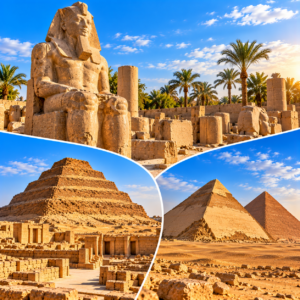
A day trip to Memphis, Saqqara, and Dahshur is one of the best ways to explore ancient Egyptian history beyond the famous pyramids of Giza. Located south of Cairo, these three archaeological destinations reveal different chapters in the development of one of the world’s most remarkable civilizations.
At Saqqara, you can discover the Step Pyramid of Djoser, an architectural landmark that helped shape the future of pyramid construction. At Dahshur, the Bent Pyramid and Red Pyramid show how ancient builders experimented with monumental structures before the great pyramids of Giza were completed. Memphis, once an important ancient capital, offers a different perspective through its surviving sculptures and the Mit Rahina Open-Air Museum.
Although these sites are relatively close to one another compared with many other Egyptian attractions, visiting all three in one day requires thoughtful planning. You will need to account for transportation, ticketing, opening hours, and the time required to explore each location.
This guide explains how to plan the trip from Cairo, which monuments deserve priority, how much time to spend at each stop, what tickets may cost, and how to make the most of your day.
Why Visit Memphis, Saqqara and Dahshur Together?
These three destinations complement one another because each offers something different.
Rather than spending the entire day exploring monuments from a single period, you can follow the development of ancient Egyptian architecture and learn about the city that supported the surrounding royal burial grounds.
Saqqara: The Beginning of Monumental Pyramid Architecture
Saqqara is best known for the Step Pyramid of Djoser, built during the Third Dynasty. Its six stacked levels represent a major development in royal funerary architecture.
The wider archaeological area also contains decorated tombs, additional pyramids, underground burial complexes, and monuments from different periods.
For many visitors, Saqqara is the most varied stop of the day. It deserves enough time to explore the Step Pyramid complex and at least one additional monument if access and your schedule permit.
Dahshur: Two Remarkable Royal Pyramids
Dahshur is especially important for understanding how ancient Egyptian builders refined pyramid design.
The Bent Pyramid has a distinctive change in slope, while the Red Pyramid represents a more regular smooth-sided form. Both are associated with King Sneferu, whose building projects were important in the development of pyramid architecture.
Dahshur is a rewarding stop for travelers interested in engineering, ancient history, and the differences between Egypt’s pyramid designs.
Memphis: The Ancient Capital
Memphis was one of ancient Egypt’s major political, administrative, and religious centers. Today, visitors mainly explore the Mit Rahina Open-Air Museum, where important surviving monuments are displayed.
The main highlights include the colossal statue of Ramesses II and an alabaster sphinx.
Memphis is a more compact visit than Saqqara or Dahshur, making it a useful final stop on a day focused on the archaeological sites south of Cairo.
Can You Visit All Three Sites in One Day?
Yes. Visiting Memphis, Saqqara, and Dahshur in one day is possible, particularly if you arrange transportation in advance and focus on the main attractions.
However, this is a full sightseeing day rather than a relaxed exploration of every monument. Saqqara alone contains enough attractions to occupy several hours, while entering a pyramid or visiting multiple tombs can add considerable time.
A private driver is generally the most practical option because you can move between sites without having to organize several separate transfers.
For a successful day trip:
- Start early from Cairo.
- Decide which monuments are most important to you.
- Check ticket requirements before departure.
- Leave time for travel between the sites.
- Avoid planning too many interior visits.
- Confirm the last-entry time for every location.
If you prefer to explore tombs in detail, enter several pyramids, or spend time with a specialist guide, consider splitting the sites across two days.
The Best Route: Dahshur, Saqqara and Memphis
For a focused day trip, a practical route is to start at Dahshur, continue to Saqqara, and finish at Memphis.
This order allows you to visit the southernmost site first and then move toward the Saqqara and Mit Rahina area. Your exact travel time will depend on where you are staying in Cairo, road traffic, and the route chosen by your driver.
Stop 1: Dahshur Pyramids
Suggested time: 1.5–2 hours
Begin your morning at Dahshur, where the Bent Pyramid and Red Pyramid are the main attractions.
Start with the Bent Pyramid. Its unusual profile makes it one of the most distinctive ancient pyramids in Egypt, and its surviving outer limestone casing provides a useful reminder of how finished pyramids originally looked.
Continue to the Red Pyramid, which is notable for its more regular shape and reddish exposed stone.
If interior access is available, you may decide to enter one of the pyramids. However, the passages can be narrow, steep, and physically demanding. Allow additional time if you choose this option.
Prioritize: the Bent Pyramid and Red Pyramid.
Time-saving tip: If your main goal is to see the monuments from outside, you can keep this stop relatively short and spend more time at Saqqara.
Stop 2: Saqqara Archaeological Site
Suggested time: 2.5–3 hours
Saqqara should be the main focus of the day because it contains a wide range of monuments.
Begin with the Step Pyramid of Djoser, the site’s most famous landmark. Walk around the complex to appreciate its stepped design and understand why it represents such an important stage in the history of pyramid construction.
Next, choose additional attractions according to your interests and current access arrangements.
Good options include:
- The Pyramid of Unas: Known for its ancient Pyramid Texts, which are important for understanding Egyptian royal funerary beliefs.
- Tombs of the nobles: Decorated tombs that reveal details about daily life, work, food production, and religious traditions.
- The Tomb of Mereruka: An important decorated tomb that offers insight into the life and status of an elite official.
- The Serapeum: An underground burial complex associated with the sacred Apis bulls.
- The Imhotep Museum: A museum that provides archaeological context for the Saqqara area.
You will not realistically have time to explore every attraction in detail if you also want to visit Dahshur and Memphis. Select two or three priorities beyond the Step Pyramid, and check whether each requires a separate ticket.
Prioritize: the Step Pyramid of Djoser and one or two additional attractions.
Stop 3: Memphis and the Mit Rahina Open-Air Museum
Suggested time: 45–60 minutes
Finish the day at Memphis, near the modern village of Mit Rahina.
The visit is relatively compact, so it works well as the final stop after the larger archaeological areas.
The most famous exhibit is the colossal statue of Ramesses II. Its enormous scale and surviving carved details make it one of the museum’s principal attractions.
You can also see the alabaster sphinx and other archaeological displays connected with the ancient city.
Memphis is especially useful for understanding the historical relationship between the ancient capital and the royal cemeteries that developed around it.
Prioritize: the colossal statue of Ramesses II and the alabaster sphinx.
Time-saving tip: Memphis is not a fully preserved ancient city with extensive standing streets and buildings. Plan for a focused museum visit rather than expecting a large complex of intact ruins.
Suggested One-Day Itinerary
The following is a planning framework, not a guaranteed timetable. Travel times and monument access can change, so confirm the opening arrangements before your visit.
| Approximate time | Activity |
|---|---|
| 7:00 AM | Leave Cairo with your driver |
| 8:00–9:45 AM | Visit Dahshur and see the Bent and Red pyramids |
| 9:45–10:30 AM | Travel toward Saqqara |
| 10:30 AM–1:15 PM | Explore the Step Pyramid and selected Saqqara monuments |
| 1:15–1:45 PM | Lunch or a short break |
| 1:45–2:15 PM | Travel to Memphis, allowing extra time if needed |
| 2:15–3:15 PM | Explore the Mit Rahina Open-Air Museum |
| After 3:15 PM | Return to Cairo, depending on traffic and your plans |
The schedule assumes a relatively focused visit and no lengthy interior exploration. If you are visiting during Ramadan, or if a site has an earlier last-entry time, you may need to adjust the order or shorten your stops.
Start earlier if possible, and avoid arriving at any archaeological site close to its last-entry time.
Memphis, Saqqara and Dahshur Ticket Prices
Ticket prices depend on the site, visitor category, and monuments you want to enter. Some attractions have separate tickets, so the basic site-admission price does not necessarily cover every pyramid interior or tomb.
The official Ministry of Tourism and Antiquities listings currently show the following general admission prices for foreign adult visitors:
| Site | General admission |
|---|---|
| Dahshur | EGP 200 |
| Saqqara archaeological area | EGP 600 |
| Memphis Open-Air Museum | EGP 200 |
| Total for the three basic site admissions | EGP 1,000 |
This total is for general admission only. It excludes transportation, food, guiding services, and any separately ticketed attractions or interior access.
At Saqqara, the official listing also offers an inclusive ticket for EGP 1,400 for foreign adults. It covers the site, Imhotep Museum, selected noble and New Kingdom tombs, the Tomb of Mereruka, and the Tomb of Mehu. Confirm the precise inclusions before purchasing, especially if you want to enter the Step Pyramid or visit the Serapeum.
Published prices and opening arrangements can change. Check the official listings before departure:
- Saqqara — Ministry of Tourism and Antiquities
- Dahshur — Ministry of Tourism and Antiquities
- Official Memphis ticket portal
Opening Hours and Last Entry
The official listings generally show morning opening for all three sites, but the last-entry times are important when planning a combined excursion.
- Dahshur: The monument page lists 8:00 AM–5:00 PM, while the ticket portal lists 4:00 PM as the standard last-entry time.
- Saqqara: The main archaeological site listing gives 8:00 AM–4:00 PM. Individual monuments may have different arrangements.
- Memphis: The official ticket portal lists 8:00 AM opening and 4:00 PM last entry under standard summer and winter schedules.
Ramadan schedules may be shorter. Confirm the live listings for your travel date and plan to arrive well before the last-entry time.
Because Saqqara contains the most attractions, it is worth giving that stop a protected block of time rather than letting the earlier visits run too long.
How to Get to Memphis, Saqqara and Dahshur from Cairo
There are several ways to arrange the trip, but the best option depends on your budget and how independently you want to travel.
Private Driver
A private driver is usually the most convenient option for visiting all three sites in one day.
You can agree on the itinerary in advance, arrange pickup from your hotel, and move between archaeological sites without organizing separate transfers.
Before booking, confirm:
- The total price and what it includes.
- Whether waiting time at each site is included.
- Whether parking and other fees are extra.
- The planned order of the stops.
- The expected return time to Cairo.
A driver does not automatically include a licensed guide, so confirm whether historical guiding is part of the arrangement.
Guided Day Tour
A guided tour can combine transport with explanations of the sites’ history and architecture.
This is particularly useful at Saqqara, where the archaeological landscape is extensive and many monuments are not immediately self-explanatory.
Before booking, check whether entrance tickets, lunch, guide services, and any pyramid interior tickets are included or charged separately.
Taxi or Ride-Hailing Service
A taxi or ride-hailing service may work for parts of the journey, but relying on separate rides between all three sites can make the day less predictable.
If you use this option, arrange return transport in advance and confirm how long the driver will wait.
Public Transportation
Public transportation can be more economical, but reaching all three sites in one day may involve several transfers and local transport arrangements.
It is better suited to travelers who have time to research the routes and are comfortable managing changes independently. For a first-time visitor trying to see all three sites in one day, a private driver or organized tour is generally simpler.
Is a Guide Worth It?
A knowledgeable guide can make the trip significantly more informative, especially if you are interested in ancient Egyptian history rather than simply photographing the monuments.
At Dahshur, a guide can explain why the Bent Pyramid changes angle and how the Red Pyramid represents a different stage in pyramid construction.
At Saqqara, a guide can help you understand the Step Pyramid, the significance of decorated tombs, and the religious meaning of the Pyramid Texts.
At Memphis, historical context is particularly useful because much of the ancient city no longer survives as standing architecture.
If your main goal is a relaxed sightseeing day, you may prefer a driver and independent exploration. If you want to understand the connections between the sites, consider booking a licensed guide for the excursion.
Best Time to Take the Day Trip
The cooler months are generally more comfortable for exploring archaeological sites around Cairo. However, the most important practical choice is often the time of day rather than the season alone.
Start Early in the Morning
An early start gives you more time to explore and helps reduce the amount of walking you do during the hottest part of the day.
It also provides flexibility if you encounter traffic, ticket queues, or changes to monument access.
Visiting During Summer
Summer visits require extra preparation because much of the archaeological landscape is exposed to the sun.
Carry drinking water, wear breathable clothing, use sun protection, and take breaks when needed. Avoid planning a demanding pyramid interior visit immediately after several hours of outdoor walking if you are already tired.
Visiting During Winter
Winter is often comfortable for outdoor sightseeing, but mornings can be cooler. Bring a light layer and comfortable walking shoes.
Regardless of the season, verify the opening hours and last-entry times before setting off.
What to Wear and Bring
A day trip covering three archaeological sites involves walking, outdoor exposure, and time spent in historic environments.
Comfortable shoes: Wear footwear suitable for uneven, sandy, or dusty ground.
Drinking water: Carry enough for the journey, particularly during warmer weather.
Sun protection: A hat, sunglasses, and sunscreen are useful at all three sites.
Breathable clothing: Dress for the weather and choose clothing suitable for walking around archaeological monuments.
A small bag: A compact bag is easier to manage if you decide to enter a pyramid with narrow passages.
Cash and payment options: Confirm accepted payment methods before departure and carry a backup payment option.
Your tickets and identification: Keep tickets accessible, and bring valid student identification if you intend to use student admission.
A charged phone: You may need it for contacting your driver, checking directions, or taking photographs.
Common Mistakes to Avoid
Trying to See Every Monument
Saqqara alone contains enough attractions to occupy several hours. Trying to visit every tomb, pyramid, and museum in addition to Dahshur and Memphis can make the trip feel rushed.
Choose your priorities before leaving Cairo.
Arriving Too Late
The last-entry time may be earlier than the published closing time. Arriving late can prevent you from entering a site or visiting a particular monument.
Start early and check the current schedule for each stop.
Assuming Every Interior Is Included
General admission may not include the interior of a pyramid or access to certain tombs. Review the ticket options carefully, especially at Saqqara.
Underestimating the Distance Between Sites
Although the destinations are in the same general region, you still need time for road travel and parking. Traffic conditions can affect the schedule.
Forgetting That Memphis Is a Compact Visit
Memphis is historically important, but the modern visitor experience centers on the Mit Rahina Open-Air Museum. Plan a focused stop rather than expecting an entire ancient city to remain standing.
Is This Day Trip Worth It?
Absolutely, particularly if you are interested in ancient Egyptian history and want to see more than the most famous pyramids at Giza.
The three destinations work well together because they offer different perspectives on the same broader civilization.
At Dahshur, you can explore two important stages in pyramid design. At Saqqara, you can discover early monumental architecture and decorated tombs. At Memphis, you can learn about the ancient capital and see surviving royal sculpture.
The main drawback is the amount of planning required to fit everything into one day. If you prefer a slower pace, divide the destinations across two days. If you are comfortable with a full sightseeing schedule, an early start and a private driver can make the combined trip practical and rewarding.
Frequently Asked Questions
Can you visit Memphis, Saqqara and Dahshur in one day?
Yes. It is possible to visit all three in one day if you start early, arrange transport in advance, and focus on selected highlights. A detailed exploration of every monument would require more time.
Which site should you visit first?
Dahshur is a practical first stop because it lies farther south. You can then continue to Saqqara and finish at Memphis. Your driver may suggest a different order depending on traffic and current opening arrangements.
How much are tickets for all three sites?
The current listed general admission prices for foreign adults are EGP 200 for Dahshur, EGP 600 for Saqqara, and EGP 200 for Memphis. That gives a basic admission total of EGP 1,000, excluding transport and separately ticketed monuments.
Is a private driver necessary?
Not necessarily, but it is the most convenient option for a one-day trip covering all three sites. Public transport and separate taxi journeys may require more planning and make the schedule less predictable.
Is Memphis worth visiting?
Yes, particularly if you are interested in the history of ancient Egypt’s capital and royal sculpture. The Mit Rahina Open-Air Museum is a compact stop, with the colossal statue of Ramesses II and the alabaster sphinx among its main highlights.
Which site deserves the most time?
Saqqara generally deserves the longest stop because it contains a wide range of pyramids, tombs, and archaeological attractions. Dahshur and Memphis can be shorter visits if you focus on their main highlights.
Can you enter the pyramids at Dahshur?
Interior access depends on current site arrangements. Check the official information before traveling, and remember that the passages can be narrow and physically demanding.
Should you combine this trip with Giza?
You can, but visiting Giza as well may make the day too rushed. It is usually better to dedicate a separate visit to the Giza Plateau and use this excursion to explore Memphis, Saqqara, and Dahshur.
What is the best time to leave Cairo?
An early morning departure gives you the most flexibility. It allows more time at the sites and reduces the risk of arriving close to last entry.
Final Thoughts
A Memphis, Saqqara, and Dahshur day trip from Cairo offers an excellent introduction to the history of ancient Egyptian cities, royal cemeteries, and pyramid construction.
The best approach is to start early, arrange transport in advance, and decide which monuments matter most to you. Give Saqqara the largest share of your time, explore the Bent and Red pyramids at Dahshur, and finish with the main exhibits at Memphis.
Check official ticket prices and opening arrangements before traveling, especially if you want to enter a pyramid or visit specific tombs. With realistic expectations and a well-planned route, this excursion can become one of the most rewarding archaeological experiences of your stay in Cairo.