
Cairo Travel Tips: 25 Things You Should Know Before Visiting
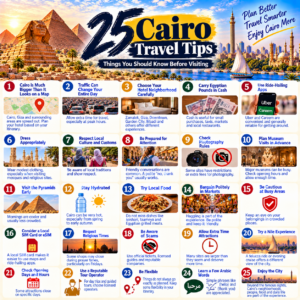
Cairo can be easy to enjoy once you understand how the city works.
The biggest mistake first-time visitors make is treating Cairo like a compact sightseeing destination where everything is close together and every part of the day follows a predictable schedule. It doesn’t. Cairo is enormous, traffic can reshape your itinerary, and the experience changes dramatically from one neighborhood to another.
That does not mean you need to arrive prepared for every possible situation. A few practical decisions make a much bigger difference: choosing the right neighborhood, carrying some Egyptian pounds, allowing extra time for traffic, dressing appropriately for religious sites, understanding how photography rules work, and knowing when to simply say no to a persistent vendor.
Cairo is also a city where flexibility helps. Your planned 20-minute journey may take much longer, a museum visit may take more energy than expected, and the busiest street can sometimes turn into the most memorable part of your evening.
Here are 25 things worth knowing before you visit Cairo.
1. Cairo Is Much Bigger Than It Looks on a Map
The first thing to understand is the city’s geography.
Cairo, Giza, and the surrounding metropolitan area form a huge urban region. The Pyramids are in Giza, west of the Nile, while Downtown Cairo, Zamalek, Historic Cairo, Maadi, Heliopolis, and New Cairo are spread across different parts of the metropolitan area.
That means choosing your hotel based only on the price can create unnecessary travel every day.
If the Pyramids are your main priority, staying in Giza can make sense. If you want museums, restaurants, Downtown, and Historic Cairo, a more central neighborhood may be more convenient.
2. Traffic Can Change Your Entire Day
Cairo traffic is one of the most important practical realities for visitors.
A journey that looks short on a map can take much longer at busy times. The U.S. State Department specifically warns that driving in Cairo can be challenging because of traffic conditions, road behavior, pedestrians, and vehicles.
The practical lesson is simple: don’t build your itinerary around exact travel times.
Leave a buffer between major activities, particularly if you have tickets for a specific time or need to reach the airport.
3. Choose Your Hotel Neighborhood Carefully
Where you stay can matter almost as much as which hotel you choose.
For many first-time visitors, Zamalek offers a useful balance of central location, restaurants, cafés, and a relatively relaxed neighborhood atmosphere.
Giza is more convenient if the Pyramids and Grand Egyptian Museum are the main focus.
Downtown works well for travelers interested in the Egyptian Museum, central Cairo, public transportation, and more budget-oriented accommodation.
Garden City is quieter and more upscale, while Maadi is more residential.
The best area depends on your itinerary rather than a universal ranking.
4. Egyptian Pounds Are Still Important
Egypt is increasingly card-friendly, especially in hotels, larger restaurants, and major tourist businesses. However, Egypt’s official tourism portal notes that the country remains cash-based in many everyday situations, including taxis and small shops.
Carry some Egyptian pounds for:
- Small shops
- Local cafés
- Tips
- Short taxi journeys
- Small entrance-related expenses
- Street food and informal purchases
You don’t need to carry a huge amount of cash. Keeping a reasonable amount available is simply more convenient.
5. Don’t Depend Entirely on Your Credit Card
Even if your hotel accepts cards, your next taxi driver, small restaurant, market stall, or local shop may prefer cash.
A useful strategy is to keep your main money and a smaller daily amount separately.
ATMs are available in Cairo, but having some local currency when you leave your hotel means you don’t have to search for an ATM every time you need a small purchase.
6. Check Your Visa Requirements Before Flying
Visa rules depend on nationality, so don’t assume that another traveler’s experience applies to you.
Egypt’s official e-Visa portal lists eligible nationalities and explains the application process. Eligible travelers applying online are instructed to submit their application at least 7 days before departure.
The official portal currently lists tourism e-Visas for eligible nationalities, including single-entry and multiple-entry options. It also states that passports should be valid for at least six months from arrival and that travelers should carry a printed e-Visa when applicable.
Check the official requirements for your nationality before booking your trip around assumptions.
7. Keep a Copy of Your Passport and Travel Documents
Keep digital copies of your passport, visa, flight information, travel insurance, and important reservations.
You should still carry your original passport when required, but having a secure backup can make things considerably easier if your documents are lost.
The U.S. State Department and UK government travel guidance both recommend keeping copies of important travel documents separately from the originals.
8. Learn a Few Arabic Words
You can travel around Cairo without speaking Arabic, particularly in hotels and major tourist areas.
Still, a few words can make everyday interactions easier.
Useful expressions include:
- Hello: Ahlan
- Thank you: Shukran
- Please: Min fadlak / Min fadlik
- Yes: Na’am
- No: La
- How much?: Bikam?
- Enough: Kifaya
- No, thank you: La, shukran
You don’t need perfect pronunciation. Making the effort is usually more useful than knowing dozens of words.
9. Dress More Conservatively for Religious Sites
Cairo is not a place where tourists need to dress identically to local residents.
But religious sites are different.
Egypt’s official tourism guidance recommends modest clothing for mosques, churches, synagogues, and other places of worship, with shoulders and legs covered. It also recommends carrying a scarf or light cardigan for visits to certain landmarks.
A lightweight layer in your day bag can therefore be useful even when the weather is hot.
10. Comfortable Shoes Matter More Than You Think
Cairo sightseeing involves much more walking than many visitors expect.
You may walk through museum galleries, archaeological areas, markets, historic streets, and uneven surfaces all on the same day.
Egypt’s official tourism guidance specifically recommends comfortable shoes for archaeological sites.
Your most stylish shoes are not necessarily your best travel shoes.
11. Learn How to Handle Tipping
Tipping is part of everyday life in Egypt.
You may encounter situations where a small tip is expected or appreciated, particularly for certain services.
Don’t feel that every person who speaks to you automatically deserves money. The better approach is to understand which service you actually received and tip accordingly.
Keep small Egyptian notes available so that you are not forced to make awkward change every time.
12. Expect Vendors at Major Tourist Sites
The Pyramids, markets, and other major tourist attractions can attract persistent vendors and unofficial guides.
Some may approach you with offers for souvenirs, camel rides, tours, photographs, or supposedly free services.
Official travel guidance warns visitors about scams, overcharging, and aggressive touts in tourist areas.
A polite but firm “No, thank you” is often enough.
You do not need to explain yourself or argue.
13. Be Careful With “Free” Offers
If someone at a tourist site says something is free, make sure you understand exactly what that means.
A free photograph, free gift, helpful direction, or complimentary service can sometimes turn into a request for money afterward.
This does not mean you should distrust everyone you meet. It simply means you should clarify prices before accepting services.
14. Agree on Prices Before Services Begin
This is especially useful for informal services.
Before accepting a ride, guide service, horse or camel ride, photograph, or other paid activity, ask:
“How much?”
If the price is unclear, ask again.
Once you agree, you have avoided one of the most common sources of unnecessary arguments.
15. Don’t Try to Drive Yourself Around Cairo
For most visitors, renting a car is more trouble than it is worth.
Cairo’s traffic, road behavior, pedestrian movement, and unfamiliar driving environment can make self-driving stressful. The U.S. State Department specifically advises travelers to consider taxis or hired drivers rather than driving themselves.
For sightseeing, a combination of taxis or ride services, walking, and the metro can be more practical.
16. The Cairo Metro Can Be Useful
Cairo has a large metro network, and it can be particularly useful when roads are heavily congested.
The official Cairo Governorate metro information lists three operating lines and identifies useful tourist-access stations, including Sadat near Tahrir Square and the Egyptian Museum, Opera for access toward Zamalek, Giza for connections toward the Pyramids, and Mar Girgis for Coptic Cairo.
Current official fares are distance-based. As of 2026, standard tickets range from EGP 10 for up to nine stations to EGP 20 for journeys of more than 23 and up to 39 stations.
You don’t have to use the metro for every journey. But knowing where it fits into your itinerary can save time.
17. Give Yourself More Time Than Google Maps Suggests
Navigation apps are useful, but Cairo is a city where estimated travel times can change quickly.
Construction, traffic, road closures, and congestion can all affect a route. The U.S. State Department also notes that navigation apps may not always reflect current road conditions in Cairo.
Use maps to understand the geography, but don’t treat every estimated arrival time as a guarantee.
18. Start Popular Sightseeing Early
The earlier part of the day can be particularly valuable for major attractions.
Starting early gives you more time before the strongest heat, leaves room for unexpected delays, and can make the experience more manageable before the day becomes crowded.
This is especially useful when combining major attractions in one day.
Rather than trying to visit five places from morning until night, choose a realistic number and give each one enough time.
19. Don’t Try to See Everything in One Day
Cairo rewards a slower itinerary.
A common mistake is combining the Pyramids, Egyptian Museum, Khan al-Khalili, Citadel, Coptic Cairo, and several other attractions into a single day.
Technically, you may be able to move between them.
But the result is often a day spent inside vehicles rather than actually experiencing Cairo.
Two or three meaningful stops can be better than six rushed ones.
20. Photography Has Rules
Don’t assume that every place in Cairo can be photographed however you want.
Egypt’s official tourism guidance allows personal, non-commercial photography in public places without a permit, including archaeological sites and museums, but indoor flash photography is not allowed. Photographing children is prohibited, and Egyptian citizens should only be photographed after obtaining written permission.
Photography is also restricted in government facilities, police stations, military-related locations, and other sensitive sites.
If a guard tells you that photography isn’t allowed, put the camera away.
21. Leave the Drone at Home Unless You Have Confirmed the Rules
Drones are not something to casually bring to Egypt for vacation footage.
The U.S. State Department says bringing drones into Egypt is illegal, while Egypt’s tourism guidance states that drones and professional equipment require government permissions.
If aerial photography is important for a professional project, investigate the permission process before traveling rather than assuming you can arrange it after arrival.
22. Ramadan Changes the Rhythm of the City
If you visit during Ramadan, expect changes to normal daily schedules.
Egypt’s tourism guide notes that shop and business hours can change during Ramadan and describes the month as a distinctive period in Egyptian life, with different rhythms between daytime and evening.
Restaurants and cafés may have different opening patterns, while evenings can become much livelier.
Instead of treating Ramadan as a problem, plan around the changed schedule.
Check opening times for attractions and businesses you specifically want to visit.
23. Be Patient With Cairo’s Pace
Cairo does not always operate according to the timetable you imagined before arriving.
Traffic can delay you. A restaurant can take longer than expected. A negotiation can take time. An attraction can be busier than anticipated.
Trying to control every minute can make the trip unnecessarily stressful.
Build some empty space into your schedule.
That flexibility is particularly valuable in a city as large and unpredictable as Cairo.
24. Keep an Eye on Your Belongings in Crowded Areas
Cairo is not a place where you need to spend your entire trip worrying about theft.
But normal precautions still make sense.
The U.S. State Department identifies crimes of opportunity such as purse snatching and pickpocketing and recommends staying alert in tourist areas.
In crowded markets and transportation areas:
- Keep your phone secure
- Use a closed bag
- Avoid displaying large amounts of cash
- Keep important documents somewhere secure
- Don’t leave valuables unattended
These are ordinary travel precautions, but they are worth following.
25. Be Flexible and Let Cairo Be Cairo
The final tip may be the most useful.
Cairo is not a perfectly polished destination where every experience happens exactly as advertised.
It is loud. It is crowded. It is historic and modern at the same time. You may encounter aggressive sales pitches, chaotic traffic, beautiful architecture, excellent food, friendly conversations, and unexpected moments within the same afternoon.
Don’t judge the whole city by your first hour.
Give yourself time to understand its rhythm.
If you plan realistically, protect your time from unnecessary complications, and remain open to experiences outside your itinerary, Cairo can become much easier to navigate.
What to Know Before Visiting Cairo: Quick Checklist
Before your flight, make sure you have:
- Checked the visa requirements for your nationality
- Confirmed your passport validity
- Saved copies of your travel documents
- Chosen your Cairo neighborhood based on your itinerary
- Downloaded an offline map
- Prepared some Egyptian pounds
- Packed comfortable walking shoes
- Packed modest clothing for religious sites
- Saved your hotel address in Arabic and English
- Checked attraction opening information
- Planned extra time for traffic
- Saved emergency and tourism contacts
- Checked current travel advisories
- Packed sunscreen, sunglasses, and a hat
- Avoided bringing restricted equipment such as drones without the required permissions
Egypt’s official tourism portal also provides tourism information and a tourism hotline at 19654, while the Tourism Police can be reached at 126.
Final Thoughts
The best Cairo travel tips are not complicated.
Choose your hotel carefully. Don’t underestimate traffic. Carry some cash. Dress appropriately for religious sites. Confirm prices before accepting services. Start major sightseeing early. Be careful with photography. Give yourself more time than you think you need.
And most importantly, don’t try to turn Cairo into a checklist.
The city is too large and too layered for that.
Build a realistic itinerary, leave room for delays, and give yourself enough time to experience the neighborhoods between the famous attractions. That’s when Cairo starts to feel less overwhelming and much more interesting.
Sources & References
- Experience Egypt — Useful Information: official tourism information covering entry visas, photography, cash, and practical travel guidance.
- Egypt e-Visa Portal: official government portal covering eligibility, application procedures, fees, and entry requirements.
- Cairo Governorate — Metro: official information on Cairo Metro lines, stations, and current fares.
- U.S. Department of State — Egypt Travel Advisory: current information on safety, transportation, photography, scams, local laws, and travel precautions.
- UK Foreign Travel Advice — Egypt: guidance on safety, scams, photography restrictions, and practical precautions.
- Experience Egypt — FAQ: official guidance on dress, photography, archaeological sites, and tourism assistance.