
Dahshur vs Giza: Which Pyramids Are Better to Visit?
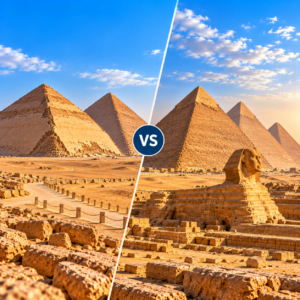
Egypt offers several extraordinary places to explore its ancient pyramids, but Dahshur and Giza provide two very different experiences. Giza is home to the Great Pyramid, the pyramids of Khafre and Menkaure, and the famous Great Sphinx. Dahshur, farther south of Cairo, is known for the unusual Bent Pyramid and the Red Pyramid, two monuments that reveal important stages in the development of pyramid construction.
If you have limited time in Egypt, choosing between these destinations can be difficult. Giza is the natural choice for first-time visitors who want to see the country’s most recognizable landmarks. Dahshur is an excellent alternative for travelers interested in ancient engineering, quieter archaeological landscapes, and the history behind the famous pyramids.
But which site offers the better experience? The answer depends on your travel style, budget, interests, and how much time you have in Cairo.
This guide compares Dahshur and Giza to help you decide which pyramids to visit, what to see at each location, how much time to allow, and whether you should include both in your itinerary.
Dahshur vs Giza: Quick Comparison
| Feature | Dahshur | Giza |
|---|---|---|
| Main attractions | Bent Pyramid and Red Pyramid | Great Pyramid, pyramids of Khafre and Menkaure, Great Sphinx |
| Historical focus | Development of smooth-sided pyramid construction | Monumental pyramid building during the Fourth Dynasty |
| Best for | Architecture enthusiasts and travelers seeking a quieter site | First-time visitors and iconic Egyptian landmarks |
| Visitor atmosphere | Generally quieter and more spread out | Busier and more developed for tourism |
| Photography | Distinctive pyramid shapes and open desert scenery | Famous panoramic views and the Sphinx |
| Suggested visit | Around 1.5–3 hours | Around 3–5 hours |
| General admission for foreign adults | EGP 200 | EGP 700 |
| Pyramid interior access | Check current arrangements | Selected pyramid interiors require separate tickets |
| Best combination | Dahshur and Saqqara | Giza and the Great Sphinx |
Ticket prices are based on current official listings and may change. Interior access and additional attractions can involve separate charges.
Why Visit the Pyramids of Giza?
For most first-time visitors to Egypt, Giza is the obvious starting point. The site contains three monumental royal pyramids and the Great Sphinx, making it one of the country’s most famous archaeological destinations.
The pyramids were built during the Fourth Dynasty of ancient Egypt. Although they are often discussed together, each monument has its own history and architectural features.
1. See the Great Pyramid of Khufu
The Great Pyramid is the main attraction at Giza. Built for King Khufu, it originally stood approximately 146.5 meters tall and remained the world’s tallest human-made structure for thousands of years.
Standing beside the pyramid gives you a sense of its extraordinary scale. The enormous blocks, sloping sides, and carefully planned structure demonstrate the abilities of ancient Egyptian builders.
Visitors can explore the exterior and surrounding archaeological area. If interior access is available, you may also purchase a separate ticket to enter the Great Pyramid.
The interior experience is physically demanding in places. Passages can be narrow and steep, so consider your mobility and comfort with enclosed spaces before deciding to go inside.
2. Explore the Other Main Pyramids
The Pyramid of Khafre is recognizable by its position on the plateau and the surviving casing near its summit. It is associated with King Khafre, who ruled after Khufu.
The Pyramid of Menkaure is smaller than the other two main pyramids but remains an important part of the Giza complex.
Seeing all three helps you understand the scale of royal pyramid construction during the Fourth Dynasty. The wider area also includes smaller pyramids, tombs, temple remains, and archaeological features connected with the royal burial complexes.
3. Visit the Great Sphinx
The Great Sphinx is another major reason to choose Giza. This enormous limestone sculpture has the body of a lion and a human head and is traditionally associated with the pyramid complex of Khafre.
The Sphinx provides a different perspective on ancient Egyptian monumental art. It is also one of the most popular places for photographs, particularly when the pyramids appear in the background.
Allow time for this area rather than concentrating only on the pyramids themselves.
4. Enjoy the Classic Pyramid Views
Giza is the stronger choice if you want the iconic photographs associated with Egypt. From selected viewpoints, you can see several pyramids together and appreciate how they dominate the surrounding landscape.
The site is well established as a major tourist destination, with more visitor services and organized tours than you will typically find at Dahshur.
Choose Giza if: you are visiting Egypt for the first time, want to see the Great Pyramid and Sphinx, or have only one opportunity to visit a major pyramid complex.
Why Visit the Dahshur Pyramids?
Dahshur offers a different experience. Instead of focusing on Egypt’s most famous monuments, it introduces visitors to the architectural experimentation that helped shape the pyramids seen today.
The two principal attractions are the Bent Pyramid and the Red Pyramid, both associated with King Sneferu, the founder of the Fourth Dynasty and father of Khufu.
1. Discover the Bent Pyramid
The Bent Pyramid is one of Egypt’s most unusual monuments. Its lower section rises at a steeper angle than its upper section, creating the distinctive change in slope that gives the pyramid its name.
The change is generally understood as an adjustment made during construction, although the full circumstances behind the decision remain a matter of archaeological interpretation.
The monument is valuable because it preserves visible evidence of the challenges ancient builders faced when constructing massive pyramids.
It also retains substantial sections of its original limestone casing, giving visitors an idea of how the exterior of a finished pyramid could look.
2. Visit the Red Pyramid
The Red Pyramid is the other major attraction at Dahshur. Its name comes from the reddish color of the exposed stone, which became visible after much of the original white limestone casing was removed.
The Red Pyramid represents an important step in the development of the smooth-sided pyramid. Its more regular shape contrasts with the Bent Pyramid nearby.
Interior access may be available, depending on current site arrangements. Entering involves a narrow, steep passage and internal chambers, so visitors should be prepared for a physically demanding experience.
Even if you choose not to enter, the Red Pyramid is worth seeing for its size, historical importance, and distinctive appearance.
3. Experience a Different Archaeological Landscape
Dahshur is particularly appealing to travelers who want to explore ancient monuments without focusing entirely on the busiest tourist attractions.
The pyramids are separated across an open landscape, and the visit often feels more centered on the monuments themselves than on a large range of visitor activities.
However, this also means that you should plan your transportation carefully. Do not assume that transport or refreshments will be as readily available as around Giza.
Choose Dahshur if: you have already visited Giza, enjoy ancient architecture, want to understand how pyramid design developed, or prefer adding a less familiar archaeological site to your itinerary.
Which Site Is Better for Understanding Pyramid History?
Both destinations are important, but they illustrate different stages of ancient Egyptian architecture.
Dahshur is particularly valuable for understanding how builders developed the smooth-sided pyramid. The Bent Pyramid shows an unusual change in slope, while the Red Pyramid demonstrates a more regular design.
Giza represents the extraordinary scale achieved by the royal pyramid builders of the Fourth Dynasty. The Great Pyramid and its neighboring monuments show how these architectural techniques developed into some of the most ambitious structures of the ancient world.
For travelers who want to understand the complete story, visiting both is much more rewarding than choosing only one.
A useful way to think about the sites is this:
- Dahshur explains the development of pyramid design.
- Giza demonstrates the monumental achievements of pyramid construction.
If ancient Egyptian engineering is your main interest, Dahshur may be more intellectually rewarding than you expect. If you want to experience the most famous examples of pyramid architecture, Giza remains the stronger choice.
Dahshur vs Giza for Photography
Both sites are excellent for photography, but they offer different subjects.
Photography at Giza
Giza is ideal for classic Egyptian travel photographs. The Great Pyramid, the other main pyramids, and the Sphinx are instantly recognizable and offer a range of possible compositions.
You can focus on individual structures, photograph multiple pyramids together, or look for views that include the surrounding desert.
Because Giza is popular, some viewpoints can be busy. Arriving early can help you enjoy the site in more comfortable conditions.
Photography at Dahshur
Dahshur is particularly interesting if you want photographs that emphasize architectural details and unusual shapes.
The Bent Pyramid’s change in slope makes it visually distinctive, while the Red Pyramid’s reddish stone creates a different appearance from the pale limestone commonly associated with Egypt’s pyramids.
The open landscape also provides opportunities to photograph the monuments with fewer surrounding distractions.
Check current photography rules before using professional equipment or photographing inside individual monuments.
Photography verdict: Choose Giza for iconic views and the Sphinx. Choose Dahshur for distinctive pyramid shapes and a more focused architectural subject.
Which Site Is Less Crowded?
Dahshur is generally a quieter alternative to Giza, although visitor numbers vary by season, day, and tour schedules.
Giza is one of Egypt’s most popular tourist destinations. Its international reputation means that visitors, tour groups, and organized excursions are a regular part of the experience.
Dahshur attracts travelers who are particularly interested in archaeology or who want to explore beyond the main Giza attractions. The setting can feel more open, and the visit often involves fewer major monuments.
However, a quieter site does not necessarily mean a simpler visit. Dahshur requires more attention to transportation and planning, particularly if you want to visit multiple pyramids or continue to Saqqara.
If avoiding crowds is your main priority, Dahshur may be the better option. If you want a wider range of major landmarks and visitor facilities, Giza has the advantage.
Dahshur vs Giza: Ticket Prices and Opening Hours
The official Ministry of Tourism and Antiquities listings currently show the following general admission prices for foreign adult visitors.
| Ticket category | Dahshur | Giza Plateau |
|---|---|---|
| Foreign adult | EGP 200 | EGP 700 |
| Foreign student | EGP 100 | EGP 350 |
These are general site-admission prices, not the total cost of every possible visit. At Giza, access to the interiors of major pyramids is charged separately. At Dahshur, you should confirm the current arrangements for entering individual pyramids.
The official electronic ticketing portal lists a last-entry time of 4:00 PM for both sites under its standard summer and winter schedules. The Giza portal lists opening from 7:00 AM, while Dahshur is listed from 8:00 AM. Ramadan schedules differ.
Check the official listings before traveling because opening hours, prices, and access rules can change.
Official sources:
- Giza Plateau — Ministry of Tourism and Antiquities
- Dahshur — Ministry of Tourism and Antiquities
- Official Giza ticket portal
- Official Dahshur ticket portal
For the best value, decide which monuments you actually want to see before buying tickets. If entering a pyramid is important to you, check the additional admission requirements rather than assuming that the general site ticket includes interior access.
How Much Time Do You Need at Each Site?
The time you need depends on whether you want a quick look at the main monuments or a more detailed archaeological visit.
Giza: Around 3–5 Hours
Allow approximately three to five hours for a substantial visit to the Giza Plateau. This gives you time to see the three main pyramids, visit the Sphinx area, take photographs, and explore some of the surrounding archaeological remains.
Allow additional time if you plan to enter a pyramid or visit other attractions that require separate tickets.
Dahshur: Around 1.5–3 Hours
A visit of around one and a half to three hours is a reasonable starting point for exploring the Bent Pyramid and Red Pyramid.
You may need more time if you want to enter an accessible pyramid interior, study the monuments in detail, or take photographs from different viewpoints.
Which Site Is Better for a Short Visit?
If you have only a few hours and want to see the most famous pyramids, choose Giza.
If you have already visited Giza and want a shorter excursion focused on pyramid architecture, Dahshur may be a better fit.
These suggested times are planning estimates, not official visit limits. Transportation, queues, and current access arrangements can affect your schedule.
Can You Visit Dahshur and Giza on the Same Day?
It is possible to visit both in one day, but it is not always the best choice.
Giza and Dahshur are separate archaeological destinations, and each involves travel time and walking. Trying to explore both thoroughly, enter pyramid interiors, and stop for meals can make the day feel rushed.
If you want to combine them, decide in advance which attractions matter most. For example, you might spend the morning at Giza and visit only one or two main monuments at Dahshur later, depending on current opening times and transportation.
However, if this is your first visit to Egypt, I recommend giving Giza a dedicated visit rather than trying to squeeze every attraction into a single day.
A more relaxed plan is to visit Giza on one day and explore Dahshur and Saqqara on another. This allows you to understand the different sites without constantly watching the clock.
Can You Combine Dahshur with Saqqara?
Yes. In fact, Dahshur and Saqqara are a natural combination for a day focused on ancient Egyptian archaeology.
Saqqara is home to the Step Pyramid of Djoser, one of the most important early monuments in the history of pyramid construction. The site also contains ancient tombs, other pyramids, and archaeological remains from different periods.
Dahshur offers the Bent Pyramid and Red Pyramid, which illustrate later stages in the development of smooth-sided pyramid architecture.
Together, the sites help tell the story of how pyramid design evolved.
A practical itinerary could look like this:
- Morning: Dahshur. Explore the Bent Pyramid and Red Pyramid while temperatures are more comfortable.
- Late morning or midday: Saqqara. Visit the Step Pyramid and select additional monuments according to your interests.
- Afternoon: Memphis, if time permits. Consider visiting the archaeological remains and museum displays before returning to Cairo.
This itinerary requires advance planning, especially if you want to enter pyramids or visit several tombs. Check each site’s ticketing and access arrangements before setting out.
How to Get to Dahshur and Giza
Transportation is an important difference between the two destinations.
Getting to Giza
Giza is a well-established tourist destination, and visitors commonly reach it by taxi, ride-hailing service, private driver, or organized tour.
If you are staying in Cairo, allow extra time for road traffic. The journey can vary considerably depending on your starting point and travel time.
Getting to Dahshur
Dahshur is farther south and is generally less straightforward to reach independently.
A private driver is a practical option because you can arrange a return journey and decide how long to spend at each monument. An organized tour can also simplify the visit, particularly if you want to combine Dahshur with Saqqara or Memphis.
If you take a taxi or ride-hailing service, arrange your return trip in advance rather than assuming a car will be readily available when you finish.
Which Is Easier to Visit?
Giza is generally easier to include in a short Cairo itinerary because it is a major tourist destination with more established visitor services.
Dahshur requires a little more planning, but the extra effort can be worthwhile if you want to explore the architectural history of the pyramids beyond Giza.
What Should You Wear and Bring?
The same basic preparation applies to both destinations.
Wear comfortable walking shoes. Archaeological sites involve walking on uneven, sandy, or dusty surfaces.
Carry water. Shade can be limited, especially in open areas.
Use sun protection. A hat, sunglasses, and sunscreen are useful in most seasons.
Dress for the weather. Choose breathable clothing during warmer months and bring an additional layer if needed in cooler weather.
Carry a small bag. Large bags can be inconvenient if you plan to enter a pyramid.
Check ticket requirements. Keep your ticket accessible and confirm whether your planned attractions require separate admission.
Start early. Morning visits are often more comfortable, particularly during hot weather.
If you plan to enter a pyramid, consider whether you are comfortable with narrow passages, steep sections, and confined spaces.
Final Verdict: Should You Visit Dahshur or Giza?
For most first-time visitors to Egypt, Giza is the better choice. The Great Pyramid, the other main pyramids, and the Great Sphinx are iconic landmarks that deserve a place on a first itinerary.
But Dahshur is far from a second-rate alternative. Its Bent Pyramid and Red Pyramid offer an important perspective on how ancient Egyptian builders developed their architectural techniques. The site can also be appealing if you prefer a quieter archaeological experience.
Choose Giza if you want:
- Egypt’s most famous pyramids.
- The Great Sphinx.
- Iconic photographs and panoramic views.
- A major attraction with established visitor services.
Choose Dahshur if you want:
- To understand the development of pyramid construction.
- To see the Bent Pyramid and Red Pyramid.
- A quieter alternative to the main Giza attractions.
- To combine pyramid visits with Saqqara.
If you have enough time, visit both. Giza shows the extraordinary scale of ancient Egyptian pyramid building, while Dahshur helps explain how that achievement developed.
For travelers with an additional day, adding Saqqara makes the experience even more rewarding. Together, these archaeological sites reveal a much richer story than any single pyramid can tell.