
Where to Stay in Cairo: Best Neighborhoods for Tourists
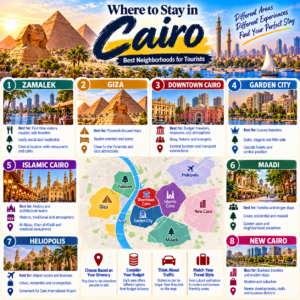
Choosing where to stay in Cairo can change the entire feel of your trip.
Cairo is not a city where every major attraction sits within a convenient central zone. Greater Cairo stretches across both sides of the Nile, with Giza to the west, the historic districts farther east, and newer residential areas extending toward the airport and the eastern edge of the metropolitan area.
That geography matters. A hotel that looks close to an attraction on a map may still require a long drive because of traffic. On the other hand, staying in a neighborhood with restaurants, cafés, museums, or the sights you care about nearby can make your days considerably easier.
For most tourists, the main choices are Zamalek, Downtown Cairo, Giza, Garden City, Islamic Cairo, Maadi, Heliopolis, and New Cairo. Each offers a different experience.
If this is your first visit, you will usually want to compare three questions before booking: What do you want to see? How much do you want to spend? And how much time are you willing to spend getting around?
Where Should Tourists Stay in Cairo?
There is no single neighborhood that works for every traveler.
Zamalek is a practical choice for visitors who want a central location, restaurants, cafés, and a calmer residential atmosphere.
Giza makes more sense if the Pyramids and the Grand Egyptian Museum are the main focus of your trip.
Downtown Cairo is useful for travelers who want a central location, budget accommodation, museums, local atmosphere, and public transportation.
Garden City suits travelers looking for upscale hotels and a quieter Nile-side setting.
Islamic Cairo is particularly interesting for visitors who want to be immersed in medieval architecture, traditional markets, mosques, and historic streets.
Maadi is better suited to longer stays and travelers who prefer a greener, more residential environment.
Heliopolis is convenient for airport access and eastern Cairo, while New Cairo is more appropriate for business trips, conferences, and travelers who specifically want modern surroundings.
The best neighborhood therefore depends less on a universal ranking and more on what your Cairo itinerary actually looks like.
Cairo Neighborhoods at a Glance
| Neighborhood | Best for | Atmosphere | Main advantage |
|---|---|---|---|
| Zamalek | First-time visitors, couples, solo travelers | Leafy, social, residential | Central location with restaurants and cafés |
| Giza | Pyramids-focused trips | Tourist-oriented, iconic | Close to the Pyramids and Giza attractions |
| Downtown Cairo | Budget travelers, museums, city atmosphere | Busy, historic, energetic | Central location and transport connections |
| Garden City | Luxury travelers | Quiet, elegant, Nile-side | Upscale hotels and central position |
| Islamic Cairo | History and architecture lovers | Historic, traditional, atmospheric | Al-Muizz, Khan al-Khalili and medieval monuments |
| Maadi | Families and longer stays | Green, residential, relaxed | Quieter pace and neighborhood amenities |
| Heliopolis | Airport access and business | Urban, residential, cosmopolitan | Convenient for Cairo International Airport |
| New Cairo | Business travelers and modern stays | Modern, suburban | Newer developments, malls and business districts |
Zamalek: A Convenient Base for First-Time Visitors
Zamalek sits on Gezira Island in the Nile and has a very different character from the busier streets of central Cairo.
Its tree-lined streets, cafés, restaurants, galleries, bookstores, and residential atmosphere make it one of the easier neighborhoods for visitors who want to explore Cairo without staying directly in the middle of its busiest streets.
Egypt’s official tourism site describes Zamalek as a leafy Nile Island neighborhood connected to both Downtown Cairo and Giza by bridges. It also highlights the area’s restaurants, cafés, galleries, boutiques, Cairo Opera House, and Cairo Tower.
For a first visit, that combination is useful. You can spend the morning sightseeing, return to the neighborhood for lunch, and have plenty of options for an evening without needing to cross the entire city again.
Zamalek is a good fit if you:
- Are visiting Cairo for the first time
- Want restaurants and cafés close to your hotel
- Prefer a neighborhood atmosphere over a purely tourist district
- Are traveling as a couple or solo
- Want to combine sightseeing with relaxed evenings
- Plan to visit museums, Downtown, and Giza during the same trip
The trade-off
Zamalek is not the closest base for the Pyramids or the major attractions of Historic Cairo.
If your entire trip revolves around ancient sites, staying in Giza may save more time.
Giza: Best for a Pyramid-Focused Trip
For many first-time visitors, seeing the Pyramids is the defining Cairo experience.
The Great Pyramid and the Giza Plateau are west of the Nile, in Giza rather than central Cairo. The Egyptian Ministry of Tourism and Antiquities identifies the Giza Plateau as the location of the Great Pyramid and the other major pyramid monuments.
Staying around the Pyramids gives you an obvious geographical advantage if you want to begin your sightseeing day nearby. Some hotels and guesthouses also have direct or elevated views toward the monuments.
Giza has become an even more relevant base for travelers interested in ancient Egypt because the Grand Egyptian Museum is also located near the Giza Plateau.
Giza is a good fit if you:
- Want to prioritize the Pyramids
- Want a pyramid-view hotel
- Plan to visit the Grand Egyptian Museum
- Have only one or two nights for the Giza side of Cairo
- Are interested in ancient Egyptian sites around the western side of the city
The trade-off
Giza does not give you the same neighborhood experience as Zamalek or Downtown.
If your itinerary includes several days of Downtown, Islamic Cairo, museums, shopping, and restaurants, you may spend more time crossing the city.
For that reason, a split stay can work well: spend a night or two around Giza, then move to a central Cairo neighborhood.
Downtown Cairo: Best for Budget Travelers and Central Sightseeing
Downtown Cairo, often known locally as Wust al-Balad, is one of the city’s most recognizable urban districts.
It is busy, noisy, historic, commercial, and full of everyday city life. The official Egypt tourism site describes Downtown as the heart of modern Cairo, with European-influenced architecture, shops, restaurants, cafés, and streets designed to be explored on foot.
The neighborhood is also particularly useful for travelers interested in museums and central attractions.
The Egyptian Museum is on Tahrir Square, and the museum’s official visitor information lists metro access as one way of reaching it.
Downtown can therefore be a practical base when you want to combine sightseeing with relatively easy access to public transportation.
Downtown is a good fit if you:
- Are traveling on a tighter budget
- Want hostels or affordable hotels
- Want to experience central Cairo’s everyday atmosphere
- Plan to visit the Egyptian Museum
- Prefer access to public transportation
- Don’t mind noise and busy streets
The trade-off
Downtown is not the neighborhood to choose if your priority is a quiet hotel surrounded by greenery.
The streets can feel intense, particularly if you are expecting a relaxed resort-style environment.
That is part of its appeal for some travelers and precisely what others may want to avoid.
Garden City: A Quieter Luxury Base
Garden City sits along the Nile south of Downtown and has a noticeably calmer atmosphere.
The area developed as a residential district and is known for grand buildings, leafy streets, diplomatic institutions, and upscale hotels. Its location also makes it possible to remain relatively central while having a more peaceful base than Downtown.
Garden City works particularly well for travelers who want a comfortable hotel and plan to spend time around the Nile, Downtown, and central Cairo.
Garden City is a good fit if you:
- Prefer upscale accommodation
- Want a quieter neighborhood
- Like Nile views
- Are traveling as a couple
- Want to stay close to central Cairo without staying in the busiest streets
- Are combining sightseeing with a more relaxed hotel experience
The trade-off
Garden City has less of the street-level energy and traditional atmosphere that travelers may be looking for in Downtown or Islamic Cairo.
It is more about the hotel and location than being immersed in Cairo’s oldest neighborhoods.
Islamic Cairo: Best for History and Architecture
If your idea of Cairo involves medieval mosques, historic gates, traditional markets, narrow streets, and Islamic architecture, staying in or close to Historic Cairo can put you much closer to that experience.
Historic Cairo is a UNESCO World Heritage Site, and Egypt’s official tourism portal highlights monuments including Al-Muizz Street, Khan al-Khalili, the Citadel, Ibn Tulun Mosque, and numerous medieval architectural complexes.
This is a different kind of Cairo experience.
Rather than using the neighborhood simply as a convenient place to sleep between sightseeing trips, you can make the surrounding streets part of the experience itself.
Islamic Cairo is a good fit if you:
- Love history and architecture
- Want to photograph historic streets
- Plan to spend substantial time around Khan al-Khalili
- Want easy access to Al-Muizz Street
- Prefer boutique or characterful accommodation
- Have already experienced central Cairo and want something more immersive
The trade-off
This is not necessarily the easiest neighborhood for every first-time visitor.
The historic districts can be busy and crowded, and the experience is very different from staying in a modern international hotel district.
For many travelers, visiting Islamic Cairo during the day while sleeping elsewhere provides a useful compromise.
Maadi: Best for Longer Stays and Families
Maadi is south of central Cairo and has a more residential character.
Egypt’s official tourism site includes Maadi among Cairo’s contemporary residential neighborhoods, alongside Zamalek and Heliopolis, emphasizing its restaurants, cafés, bakeries, boutiques, and local neighborhood atmosphere.
It can make sense for travelers who are staying in Cairo for a week or longer and do not need to be beside the main tourist attractions every morning.
Families and travelers working remotely may also appreciate having more of a residential environment.
Maadi is a good fit if you:
- Are staying for a longer period
- Prefer residential neighborhoods
- Want a quieter pace
- Are traveling with family
- Want restaurants and everyday services nearby
- Don’t mind being farther from the main tourist sights
The trade-off
For a short sightseeing trip, Maadi’s distance from many major attractions can become inconvenient.
If you have only two or three days in Cairo, being more central may save valuable time.
Heliopolis: Best for Airport Convenience
Heliopolis is in northeastern Cairo and has a distinctive architectural and urban identity.
Egypt’s official tourism portal describes it as a neighborhood with Belle Époque character, broad streets, local restaurants, shops, and the Korba area.
Its main advantage for many visitors is its position relative to Cairo International Airport.
That makes it worth considering if your trip starts or ends with a flight, especially if you have a very early departure or only a short stopover.
Heliopolis is a good fit if you:
- Have an early flight
- Have a short Cairo layover
- Are traveling for business
- Need to stay near the airport
- Want a more residential environment
The trade-off
Heliopolis is not the most convenient base for a classic first-time Cairo itinerary centered around the Pyramids, Downtown, and Historic Cairo.
You are choosing airport convenience over central sightseeing access.
New Cairo: Best for Business and Modern Comfort
New Cairo is one of the newer urban areas east of the traditional city.
It is very different from Historic Cairo and Downtown. The area is characterized by newer developments, residential compounds, shopping centers, offices, and modern hotels.
For a tourist whose main goal is to explore ancient monuments and historic Cairo, it may not be the obvious choice.
But for business travelers, conferences, or visitors with specific plans in eastern Cairo, its location can make sense.
New Cairo is a good fit if you:
- Are traveling for business
- Have meetings in eastern Cairo
- Are attending a conference
- Prefer newer buildings and modern developments
- Want to combine Cairo with destinations in the east
The trade-off
Distance is the main issue.
If most of your itinerary is centered around the Pyramids, Egyptian Museum, Khan al-Khalili, and central Cairo, staying far east can mean more time spent in transportation.
Where to Stay in Cairo Based on Your Trip
Instead of asking which neighborhood is universally best, match your accommodation to your itinerary.
For a first trip of 3–5 days
Look at Zamalek, Downtown, or Giza.
Zamalek gives you a central residential base with restaurants and cafés.
Downtown puts you close to the Egyptian Museum and central transportation.
Giza is particularly attractive if the Pyramids and Grand Egyptian Museum dominate your plans.
For a 1–2 night Cairo stop
Giza can work well if the Pyramids are your priority.
Alternatively, stay in Zamalek or Downtown if you want a broader introduction to Cairo rather than focusing mainly on ancient monuments.
For a history-focused trip
Consider Islamic Cairo, Downtown, or a central location near Historic Cairo.
Historic Cairo contains a remarkable concentration of Islamic and Coptic heritage, while Downtown gives you easier access to the modern center of the city.
For a luxury trip
Look around Garden City, Zamalek, and Nile-side central Cairo.
These areas combine central positioning with upscale accommodation and river views.
For a family trip
For a short stay, Zamalek can provide a useful balance between central access and neighborhood amenities.
For a longer stay, Maadi may be more attractive if you prefer a residential environment.
For a budget trip
Downtown Cairo is one of the first areas worth investigating.
You can also find a wide range of accommodation around Giza, particularly if pyramid access is more important to you than being centrally located.
Should You Split Your Stay Between Giza and Central Cairo?
For some itineraries, yes.
A split stay can solve one of Cairo’s biggest accommodation problems: the city is geographically spread out.
For example:
Nights 1–2: Giza
Use these days for the Pyramids, the Giza Plateau, and the Grand Egyptian Museum.
Nights 3–5: Zamalek or Downtown
Use your remaining days for Downtown, museums, Historic Cairo, Khan al-Khalili, restaurants, and exploring the central neighborhoods.
This approach is especially useful when the Pyramids are a major reason for visiting Cairo but not the only thing you want to see.
What to Check Before Booking a Cairo Hotel
The neighborhood name alone isn’t enough.
Before paying for a hotel, check the property’s exact location.
A hotel listed as “Giza” may be much farther from the Pyramids than you expect. Likewise, a hotel described as “Downtown Cairo” may be on a busy street where traffic noise continues late into the night.
Look at:
- The exact street and nearby landmarks
- Recent guest reviews
- Whether rooms are facing a busy road
- Availability of an elevator if you have heavy luggage
- Air conditioning
- Breakfast arrangements
- Reception hours if arriving late
- Distance to restaurants and cafés
- Transport options
- Whether the hotel has a rooftop or Nile/pyramid view, if that matters to you
Most importantly, look at your daily itinerary before choosing the hotel.
A cheaper room can stop being a bargain if it requires long car journeys every day.
Final Thoughts
Where you stay in Cairo should follow the trip you actually want to have.
Choose Zamalek if you want a central, leafy neighborhood with restaurants, cafés, culture, and an easier introduction to the city.
Choose Giza if the Pyramids and ancient Egypt are at the center of your visit.
Choose Downtown Cairo if you want budget options, museums, transportation, and a close-up experience of the modern city.
Choose Garden City for a quieter, upscale Nile-side stay.
Choose Islamic Cairo if historic architecture and traditional Cairo are the main attraction.
Choose Maadi for a longer, more residential stay.
Choose Heliopolis when airport access is a priority, and New Cairo when your plans are concentrated in the eastern part of the metropolitan area.
There is no need to force every Cairo itinerary into the same neighborhood. The smartest approach is to start with your sightseeing plan, identify the attractions you will visit repeatedly, and then choose the area that minimizes unnecessary travel.
That is often more important than the hotel itself.
Sources & References
- Egypt Tourism Authority / Experience Egypt — Cairo & Giza and Downtown Cairo neighborhood information.
- Egypt Tourism Authority / Experience Egypt — Historic Cairo and its major monuments.
- Ministry of Tourism and Antiquities — Giza Plateau and Great Pyramid information.
- Ministry of Tourism and Antiquities — Egyptian Museum visitor information.
- Lonely Planet — Cairo neighborhood overview.
- EgyptMore — 2026 Cairo accommodation area guide.