
25 Best Things to Do in Cairo, Egypt
Cairo is the kind of city where you can spend the morning standing beside a pyramid built thousands of years ago, have lunch in a crowded local neighborhood, walk through medieval Islamic streets in the afternoon, and finish the evening watching the Nile from a rooftop or boat.
That variety is what makes choosing the best things to do in Cairo surprisingly difficult. The city is much more than the Pyramids of Giza. Its historic neighborhoods, museums, mosques, churches, markets, gardens, viewpoints, and modern districts each reveal a different side of Egypt’s capital.
Some attractions deserve several hours, while others work better as short stops between nearby sights. And although Giza and Saqqara are technically outside Cairo’s administrative boundaries, they are commonly included in a Cairo sightseeing itinerary because of their proximity and importance.
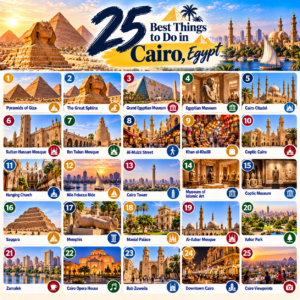
Here are 25 experiences worth considering, organized without ranking them from best to worst.
1. See the Pyramids of Giza
For most first-time visitors, the Pyramids of Giza are the obvious starting point.
The complex includes the Great Pyramid of Khufu, the Pyramid of Khafre, the Pyramid of Menkaure, and the Great Sphinx. Together they form part of the Memphis and its Necropolis World Heritage property, which stretches from the Giza pyramid fields through Saqqara and Dahshur.
The experience is more than simply taking a photograph in front of the pyramids. Walk around the plateau to appreciate their enormous scale and changing perspectives.
Allow several hours rather than rushing through the site. Early morning is generally more comfortable for walking and photography, particularly during the hotter months.
2. Get Close to the Great Sphinx
The Great Sphinx deserves its own stop even though it is part of the Giza complex.
The enormous limestone monument combines the body of a lion with a human head and stands beside the ancient structures of the Giza plateau.
One of the most interesting perspectives comes from approaching the Sphinx area after exploring the pyramids. From there, the relationship between the Sphinx, the Valley Temple, and the pyramids becomes much clearer.
The nearby Valley Temple is also worth examining rather than treating it as a quick photo stop. Its massive stone blocks give you a better sense of the engineering involved in the Giza complex.
3. Explore the Grand Egyptian Museum
The Grand Egyptian Museum has changed the way many travelers experience ancient Egyptian history.
Located near the Giza Plateau, the museum brings together a huge collection spanning thousands of years. Its permanent galleries follow the story of ancient Egyptian civilization through themes including kingship, society, and beliefs.
The building itself is part of the experience. The Grand Hall, Grand Staircase, and large-scale ancient statues create a very different atmosphere from Cairo’s older museums.
If you are particularly interested in Tutankhamun, allow substantial time for the museum rather than trying to combine it with too many other attractions on the same morning.
Because museum operations and ticket arrangements can change, check the official museum information before your visit.
4. Visit the Egyptian Museum in Tahrir
The Egyptian Museum in Tahrir offers a completely different museum experience from the Grand Egyptian Museum.
Opened in 1902, the historic museum contains an enormous collection of ancient Egyptian antiquities covering periods from the Predynastic era through the Greco-Roman period. Its collection includes objects such as the Narmer Palette, royal statues, jewelry, papyri, and sarcophagi.
The building itself is part of the attraction. Rather than the expansive modern design of GEM, Tahrir’s museum feels like a traditional early-20th-century archaeological museum.
It is particularly convenient to combine with Downtown Cairo because it sits beside Tahrir Square.
5. Walk Through Historic Cairo
Historic Cairo is where sightseeing becomes less about individual monuments and more about the city itself.
UNESCO recognizes Historic Cairo as a World Heritage property, describing it as one of the world’s historic Islamic cities, with mosques, madrasas, fountains, markets, and surviving traditional urban fabric.
Instead of moving directly from one attraction to another by car, spend time walking through the streets.
The architecture changes from one block to the next, with old facades, mosques, workshops, markets, courtyards, and narrow lanes creating an atmosphere that cannot be reproduced inside a museum.
6. Walk Al-Muizz Street
Al-Muizz Street is one of the most rewarding places to explore in Historic Cairo.
The street passes an extraordinary concentration of Islamic architecture, including historic mosques, madrasas, mausoleums, and commercial buildings.
Its importance comes not only from individual monuments but from the surrounding historic urban landscape. UNESCO identifies Qasabat al-Muizz as a major axis within Historic Cairo’s historic fabric.
Give yourself time to walk rather than simply photographing the famous buildings. The smaller architectural details, doorways, wooden screens, stone carvings, and traditional shops are part of the experience.
7. Shop at Khan el-Khalili
Khan el-Khalili is Cairo’s best-known traditional market and an easy addition to a Historic Cairo itinerary.
The market is useful for travelers who want souvenirs, jewelry, spices, decorative objects, traditional crafts, or simply the experience of wandering through a dense old commercial district.
Do not plan the visit like a conventional shopping mall. Half the attraction is getting lost among the lanes, stopping for a drink, and observing how the market works.
It pairs naturally with Al-Muizz Street because the two experiences can be combined during the same Historic Cairo outing.
8. Visit the Citadel of Saladin
The Cairo Citadel sits on the Muqattam Hills and offers one of the city’s most recognizable elevated views.
The fortress played an important role in Cairo’s medieval history and later became associated with several major monuments.
The location is particularly useful when you want to understand Cairo’s geography. From above, the dense urban landscape stretches toward the city’s historic districts.
Experience Egypt describes the Citadel as one of Historic Cairo’s major landmarks and highlights its panoramic views over the city.
9. See the Mosque of Muhammad Ali
Inside the Citadel, the Mosque of Muhammad Ali is one of Cairo’s most recognizable landmarks.
Its large domes and Ottoman-influenced architecture make it visually different from the medieval Mamluk buildings elsewhere in Historic Cairo.
The mosque is also a useful stop for understanding the architectural layers of Cairo. Historic Cairo did not stop developing in the medieval period; later rulers added their own buildings and styles to the existing city. UNESCO specifically notes the Ottoman influence represented by the Muhammad Ali Mosque at the Citadel.
10. Visit the Mosque-Madrassa of Sultan Hassan
The Sultan Hassan Mosque and Madrassa is one of the major monuments of medieval Cairo.
Its enormous scale becomes apparent when you stand outside the complex and look up at the walls and monumental entrance.
It is particularly easy to combine with the nearby Al-Rifa’i Mosque, allowing you to see two important religious buildings in the same area.
The surrounding district is also part of the broader Historic Cairo landscape recognized by UNESCO for its concentration of Mamluk architecture.
11. Explore the Mosque of Ibn Tulun
The Mosque of Ahmad Ibn Tulun is one of the most distinctive Islamic monuments in Cairo.
UNESCO highlights its large open courtyard, symmetrical arches, and famous spiral minaret as an outstanding example of early Islamic architecture.
The spacious design makes it feel different from many of Cairo’s more enclosed historic mosques.
If you are interested in Islamic architecture, this is a place to slow down and look at the geometry, arches, courtyard, and minaret rather than simply checking it off a sightseeing list.
12. Discover Coptic Cairo
Coptic Cairo introduces another layer of the city’s long history.
The district around the old Roman fortress contains historic churches, the Coptic Museum, and other important religious sites.
The Hanging Church is one of the best-known landmarks. Experience Egypt notes that the church is built over the remains of a Roman fortress and dates in its present form to the early centuries of Christian Egypt.
The area is compact enough to explore on foot, although the narrow lanes and numerous sites mean you should allow more time than you might expect.
13. Visit the Hanging Church
The Hanging Church, also known as Al-Muallaqa, is one of the defining sights of Coptic Cairo.
Its name refers to its position above the ruins of the Roman fortress.
Inside, the church contains historic icons and religious artwork. Its architecture also demonstrates how Christian heritage developed within the changing urban landscape of Cairo.
It works especially well when combined with the Coptic Museum and nearby churches rather than visited as an isolated attraction.
14. Explore the Coptic Museum
The Coptic Museum provides context for the churches around it.
Its collection includes manuscripts, icons, carved woodwork, textiles, and other examples of Coptic art from different periods of Egyptian history. Experience Egypt describes the museum as holding one of the world’s major collections of Coptic artifacts.
If you visit Coptic Cairo without entering the museum, you may see the architecture without fully understanding the artistic traditions behind it.
Allow extra time if you enjoy religious art, manuscripts, or Egyptian history beyond the pharaonic period.
15. Visit the National Museum of Egyptian Civilization
The National Museum of Egyptian Civilization, or NMEC, is useful for travelers who want to understand Egypt as a continuous civilization rather than focusing exclusively on the pharaohs.
The museum presents Egyptian history from prehistoric times through the modern era. One of its major attractions is the Royal Mummies Hall, which displays royal mummies from ancient Egypt.
This makes NMEC a particularly useful complement to the Egyptian Museum and GEM.
Rather than repeating the same collection experience, the three museums can give you three different perspectives on Egypt’s past.
16. Take a Nile River Cruise
The Nile is not just scenery in Cairo; it is part of the city’s geography and identity.
A short evening cruise can be a relaxing way to see the capital after a day of museums and monuments.
For a quieter experience, look for a traditional-style boat or felucca when conditions allow. For a more structured evening, dinner cruises provide food and entertainment.
The best choice depends on whether you want a peaceful river experience or a full evening activity.
17. Walk Along the Nile Corniche
You do not need to book a cruise to experience the Nile.
A walk along the Corniche can provide a simple break from Cairo’s historic attractions.
The riverfront connects different parts of the city and offers changing views of bridges, boats, buildings, and the opposite bank.
Around sunset, the atmosphere changes as Cairo’s lights begin to appear across the river.
18. Go Up the Cairo Tower
The Cairo Tower is one of the city’s most recognizable modern landmarks.
Located on Gezira Island in Zamalek, the tower rises 187 meters and provides a broad view across Cairo.
This is particularly useful if you want to see how enormous Cairo really is.
From street level, the city can feel like a collection of separate neighborhoods. From the tower, the dense urban landscape, Nile, bridges, and surrounding districts become much easier to understand.
19. Spend an Afternoon in Zamalek
Zamalek offers a completely different side of Cairo from Historic Cairo.
The leafy island district is known for restaurants, cafés, bookstores, galleries, and contemporary city life. Experience Egypt highlights Zamalek as one of Cairo’s modern neighborhoods and notes its location on Gezira Island.
It is a good place to slow down after several days of archaeological sightseeing.
You can combine lunch or coffee with a walk, visit the Cairo Tower, explore an art gallery, or simply enjoy the Nile views.
20. Visit the Manial Palace
The Manial Palace is one of Cairo’s more unusual architectural attractions.
Built by Prince Muhammad Ali Tewfik between 1899 and 1929, the palace combines European influences with Ottoman, Andalusian, Persian, and other Islamic architectural elements. Its grounds also include historic gardens.
The palace is especially interesting for visitors who have already seen Cairo’s ancient and medieval monuments and want something connected to the city’s royal history.
21. Explore Downtown Cairo on Foot
Downtown Cairo is best experienced at street level.
The district combines 19th-century European-influenced architecture with Egyptian urban life, cafés, shops, restaurants, cultural venues, and busy streets.
Experience Egypt describes Downtown as a living architectural museum and recommends exploring it on foot.
A walking route can include Tahrir Square, the Egyptian Museum, historic cafés, nearby streets, and Qasr El Nil Bridge.
This is also one of the easiest ways to experience Cairo beyond the traditional tourist attractions.
22. Cross Qasr El Nil Bridge
Qasr El Nil Bridge connects Downtown Cairo with Gezira Island and provides a straightforward way to experience the Nile without booking a formal activity.
The bridge is known for its bronze lion sculptures and its views along the river. Experience Egypt identifies it as one of Downtown’s recognizable landmarks and a popular place for pedestrians, particularly in the evening.
It is not a destination that requires half a day. Instead, treat it as part of a larger Downtown and Zamalek walking route.
23. Relax in Al-Azhar Park
After several hours among Cairo’s dense streets, a green space can feel like a completely different city.
Al-Azhar Park provides an opportunity to take a break, walk through landscaped areas, and look back toward parts of historic Cairo.
It works especially well late in the afternoon when you want to slow down rather than immediately move to another museum.
Pairing a park visit with Historic Cairo can create a more balanced day instead of spending every hour inside archaeological sites.
24. Watch a Whirling Dervishes Performance at Wikalat al-Ghuri
For an evening cultural experience, look for a performance at Wikalat al-Ghuri in Historic Cairo.
Experience Egypt specifically highlights authentic whirling dervishes performances at Wikalat al-Ghuri as one of the cultural experiences visitors can seek out in Cairo.
The setting is part of the appeal. Rather than watching a performance in a modern entertainment district, you are experiencing music and movement within Historic Cairo’s architectural environment.
Check the current performance schedule before planning your evening because cultural events can vary by date.
25. Take a Half-Day Trip to Saqqara
If you have more than two or three days in Cairo, consider extending your ancient-Egypt experience beyond Giza.
Saqqara is part of the wider Memphis and its Necropolis World Heritage property and is home to the Step Pyramid of Djoser, an important milestone in the development of pyramid architecture.
The experience is very different from Giza. Instead of focusing on three enormous pyramids in a concentrated plateau, Saqqara contains a wider archaeological landscape with pyramids, tombs, temples, and other remains.
It is particularly worthwhile for travelers who want to understand how Egyptian monumental architecture developed over time.
How to Choose What to Do in Cairo
You do not need to visit all 25 attractions.
For a first trip, think in terms of geographic clusters.
If you have 1 day:
Focus on Giza, the Sphinx, and either the Grand Egyptian Museum or another major museum, depending on your interests and available opening times.
If you have 2 days:
Add Historic Cairo, including Al-Muizz Street, Khan el-Khalili, the Citadel, and one or two major mosques.
If you have 3 days:
Add Coptic Cairo and NMEC, then use the evening for Downtown, Zamalek, the Nile, or Cairo Tower.
If you have 4 days or more:
You can slow the pace and add Saqqara, the Manial Palace, additional museums, or neighborhoods such as Zamalek and Downtown.
The key is not to treat Cairo as a checklist. Several of the city’s best experiences are located close enough to combine into a single outing.
Best Things to Do in Cairo for Different Travelers
For first-time visitors: Giza, the Sphinx, GEM, Historic Cairo, and Khan el-Khalili provide a strong introduction.
For history lovers: The Egyptian Museum, GEM, NMEC, Saqqara, Historic Cairo, and the Citadel offer very different historical periods.
For Islamic architecture: Al-Muizz Street, Ibn Tulun Mosque, Sultan Hassan, the Citadel, and the surrounding Historic Cairo districts are natural choices.
For Christian heritage: Coptic Cairo, the Hanging Church, the Coptic Museum, and the historic churches around the Fortress of Babylon are the main focus.
For modern Cairo: Downtown, Zamalek, Cairo Tower, Qasr El Nil Bridge, cafés, galleries, and the Nile waterfront show another side of the city.
For photography: Giza, the Citadel, Cairo Tower, Al-Muizz Street, the Nile, and Downtown provide very different visual environments.
How Many Days Do You Need in Cairo?
Three days is a practical starting point for a first visit.
With three full days, you can devote one day to Giza and the major museums, another to Historic Cairo, and another to Coptic Cairo, Downtown, Zamalek, or the Nile.
Four days gives you more breathing room and makes a Saqqara excursion easier to add.
If Cairo is only the first stop on a longer Egypt itinerary, you do not necessarily need to see everything. Luxor, Aswan, Alexandria, and the Red Sea each offer experiences that cannot be replicated in Cairo.
Tips for Visiting Cairo
Group attractions geographically. Cairo traffic can turn a short distance into a long journey, so avoid crossing the city repeatedly in the same day.
Start major outdoor attractions early. This is particularly useful for Giza and other sites where you will spend significant time walking.
Do not schedule too many museums together. Ancient Egyptian collections can become overwhelming when visited back-to-back.
Wear comfortable shoes. Historic districts, archaeological sites, and museums involve much more walking than many visitors expect.
Check official opening hours before leaving your hotel. Museum schedules, special exhibitions, performances, and ticketing arrangements can change.
Leave room for ordinary Cairo. A café, neighborhood walk, Nile view, or unplanned street stop can become one of the most memorable parts of the trip.
Final Thoughts
The best things to do in Cairo are not limited to its most famous monuments.
The Pyramids and Sphinx provide the spectacular introduction, but Historic Cairo reveals the city’s medieval character. Coptic Cairo adds another layer of history, while NMEC and the Egyptian Museum help connect different periods of Egyptian civilization. Downtown and Zamalek then show you the modern capital that exists alongside all of this history.
The most rewarding Cairo itinerary is therefore one that mixes major landmarks with time to simply experience the city.
You can spend the morning looking at ancient stone, the afternoon walking through a medieval market, and the evening beside the Nile. That contrast is what makes Cairo difficult to reduce to a simple sightseeing list.
Sources & References
- Experience Egypt — Cairo & Giza
- UNESCO — Historic Cairo
- UNESCO — Memphis and its Necropolis: Giza to Dahshur
- Ministry of Tourism and Antiquities — Egyptian Museum
- Experience Egypt — Grand Egyptian Museum
- Ministry of Tourism and Antiquities — National Museum of Egyptian Civilization
- Experience Egypt — Historic Cairo
- Experience Egypt — Downtown Cairo & City Breaks