
7 Days in Egypt: The Perfect First-Time Itinerary
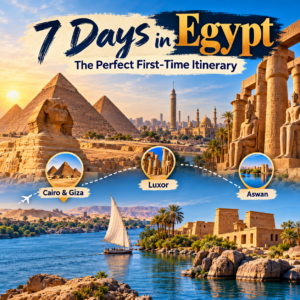
Seven days is enough to experience some of Egypt’s biggest highlights, but it is not enough to see everything. The trick is choosing a route that makes sense geographically and leaves enough time to actually enjoy each destination.
For a first trip, a practical route is Cairo and Giza → Luxor → Aswan. It combines the pyramids and major attractions around the capital with the temples and tombs of Luxor and the Nile landscapes of southern Egypt.
Cairo and Giza provide the starting point, with the Giza Plateau, historic Cairo and the city’s museums and neighborhoods. Luxor then shifts the focus almost entirely toward ancient Egyptian monuments, with major sites on both banks of the Nile. Aswan provides a slower final stop, with the Nile, Philae Temple, Nubian culture and the possibility of continuing to Abu Simbel.
The itinerary below is designed for travelers who want a strong first introduction to Egypt without spending most of the week in transit.
Your 7-Day Egypt Itinerary at a Glance
| Day | Destination | Main focus |
|---|---|---|
| Day 1 | Cairo | Arrival and easy introduction to the city |
| Day 2 | Cairo & Giza | Pyramids, Sphinx and Cairo sights |
| Day 3 | Cairo → Luxor | Travel south and explore Luxor |
| Day 4 | Luxor | East and West Bank highlights |
| Day 5 | Luxor → Aswan | Nile journey and riverside attractions |
| Day 6 | Aswan | Philae, Nile and Nubian experiences |
| Day 7 | Aswan → Departure | Departure or onward journey |
This route assumes that your international flight arrives in Cairo and that you can arrange your departure from Aswan or return to Cairo at the end.
If your international flights are already booked as round trips from Cairo, the final day needs to be adjusted to include the journey back north.
Day 1: Arrive in Cairo and Keep the First Day Light
Your first day should not be overloaded with sightseeing.
International arrivals can involve immigration, baggage collection, transportation to your hotel and checking in. Cairo is also a large, busy city, so giving yourself time to settle in can make the rest of the itinerary easier.
Once you are checked in, use the afternoon or evening for something relatively simple.
A walk along the Nile, dinner in your neighborhood or a relaxed introduction to Cairo can be enough.
Cairo’s official tourism profile describes the city as a huge metropolitan area centered around the Nile, with historic districts, Downtown Cairo and contemporary neighborhoods all offering different experiences.
What to do on your first evening
Depending on your arrival time, you could:
- Walk along the Nile
- Have dinner at a local restaurant
- Explore your hotel neighborhood
- Visit a nearby café
- Rest before the following day’s sightseeing
Do not schedule the pyramids immediately after a long-haul flight unless your arrival time makes it genuinely practical.
Where to stay
For a first visit, location matters.
Downtown Cairo can be useful for travelers who want to experience the city, while Giza can be convenient if the pyramids are the immediate priority.
The important thing is to choose your hotel before arrival based on your itinerary rather than simply choosing the lowest room rate.
Day 2: Giza Pyramids and Cairo
This is the day most first-time visitors have been waiting for.
Start with Giza.
The Giza Plateau is part of the UNESCO World Heritage Site of Memphis and its Necropolis and includes the Great Pyramid, the pyramids of Khafre and Menkaure, the Sphinx and numerous surrounding monuments.
Morning: Giza Plateau
Give yourself several hours for the Giza area rather than treating it as a quick photo stop.
You can explore the major pyramid complexes and the Sphinx, while the wider archaeological landscape provides more to see than the three main pyramids alone.
If entering a pyramid is important to you, check current ticketing and access arrangements before your visit.
Afternoon: Choose One Cairo Focus
After Giza, avoid trying to visit every major Cairo attraction in the same afternoon.
Choose one main focus.
You could explore historic Cairo, visit a museum, or spend time around central Cairo.
The official tourism authority highlights Historic Cairo, Giza and Downtown Cairo as distinct experiences within the city.
Evening: Cairo at Your Own Pace
Keep the evening flexible.
You could explore Khan al-Khalili, have dinner or simply rest at your hotel.
The goal is to avoid turning your first full day into an exhausting checklist.
Day 3: Cairo to Luxor
Day three is when the itinerary changes character.
You leave the enormous urban environment of Cairo and head south toward Luxor.
Egypt’s official tourism information lists domestic flights and rail travel among the main ways to travel between cities. It notes that domestic flights can connect major destinations quickly, while trains provide an overland alternative along the Nile Valley.
For a seven-day itinerary, the choice should be based primarily on how much time you want to preserve for sightseeing.
Option 1: Fly
A domestic flight can reduce the amount of time spent traveling between Cairo and Luxor.
This can be particularly useful when you only have seven days.
Option 2: Train
Traveling by train gives you a different perspective on the Nile Valley and can be a reasonable option if you prefer overland travel.
The official tourism authority lists trains as an option for heading south toward Luxor and Aswan.
Afternoon in Luxor
Once you arrive and check in, use the remaining time for one manageable attraction.
Luxor Temple can work well because it is located on the East Bank and provides an introduction to the scale of the city’s ancient monuments.
Luxor is divided by the Nile into the East Bank and West Bank, with Karnak and Luxor temples among the major East Bank attractions.
If you arrive late, simply have dinner and rest.
You have a full day in Luxor tomorrow.
Day 4: Explore Luxor’s Ancient Sites
Day four is the most archaeology-heavy day of the itinerary.
Luxor was the ancient city of Thebes and is home to a concentration of major temples, tombs and monuments. The official tourism authority describes the city as an open-air museum, divided into East and West Bank areas by the Nile.
Morning: West Bank
Start on the West Bank.
The main possibilities include:
- Valley of the Kings
- Temple of Hatshepsut at Deir al-Bahari
- Colossi of Memnon
- Other archaeological sites depending on your interests and available time
The Valley of the Kings contains royal tombs, while the Temple of Hatshepsut is one of the major monuments on the West Bank.
Do not try to visit every tomb simply because it is possible. Choose the sites that interest you most and leave time to appreciate them.
Afternoon: Karnak Temple
After lunch and a break, visit Karnak.
Karnak is a huge temple complex on Luxor’s East Bank and one of the defining archaeological attractions of the city.
Its scale is one reason not to rush the visit.
Evening: Nile or Luxor
After a full day of sightseeing, keep the evening simple.
A Nile-side dinner or quiet walk can provide a useful change of pace.
Day 5: Luxor to Aswan
Day five is your transition from Luxor to Aswan.
This is where you have an important choice: travel directly to Aswan or make the journey part of the Nile experience.
Egypt’s official tourism authority says that numerous Nile cruises operate between Luxor and Aswan, generally on itineraries lasting several nights, with stops at major attractions.
A full cruise is not always compatible with a seven-day itinerary, but if you have arranged a shorter Nile journey or another suitable river transfer, it can be incorporated into the route.
If You Travel Directly
Take the morning to travel to Aswan, check into your hotel and use the afternoon to explore.
If You Use a Nile Cruise
Your schedule will depend on the cruise itinerary.
Cruise routes can include sites between Luxor and Aswan such as Edfu and Kom Ombo. The official tourism authority notes that these monuments can also be reached by land.
Evening in Aswan
Aswan is a good place to slow the itinerary down.
The official tourism authority describes it as a quieter Nile city with islands, Nubian culture, markets and riverside scenery.
A sunset felucca ride can be a natural way to end the day if weather and local conditions allow.
Day 6: Aswan and Abu Simbel
Your final full day should focus on Aswan rather than trying to add another major city.
Morning: Philae Temple
Philae is one of the major historical attractions associated with Aswan.
The temple complex is located on an island and forms part of the UNESCO-listed Nubian Monuments from Abu Simbel to Philae.
Allow enough time for the journey and the visit rather than treating it as a quick stop.
Afternoon: Nubian Culture or Aswan
After Philae, choose a slower afternoon.
You could explore Aswan’s market, spend time beside the Nile, visit a Nubian village through a reputable local operator, or simply relax.
The official tourism authority highlights Nubian culture, traditional markets, islands and the city’s Nile scenery as key parts of the Aswan experience.
What About Abu Simbel?
Abu Simbel is one of the most famous attractions in southern Egypt, and the official tourism authority includes it among the major sites around Aswan.
However, fitting Abu Simbel into a seven-day itinerary depends on your transportation and departure plans.
If Abu Simbel is a personal priority, consider replacing some of the slower Aswan activities with the excursion rather than trying to add it on top of an already full day.
Day 7: Departure From Aswan
Your final day depends on your flight arrangements.
If Flying Home From Aswan
Keep the morning flexible and leave enough time to reach the airport.
If Returning to Cairo
Allow sufficient time for the domestic journey and your international departure.
Do not schedule a tight connection between a domestic flight and an international flight unless the tickets and connection arrangements give you appropriate protection.
If your international ticket is a round trip from Cairo, another option is to spend the final night in Cairo before the international departure.
Why This Route Works for a First Trip
The main advantage of this itinerary is that each destination serves a different purpose.
Cairo and Giza introduce you to modern Egypt while providing access to the pyramids and major historical sites.
Luxor concentrates the trip around ancient temples and tombs.
Aswan changes the pace and adds the Nile, Nubian culture and access to Philae and Abu Simbel.
These destinations also follow the Nile Valley naturally. Egypt’s official tourism authority organizes its Nile region around Cairo and Giza, Luxor, Aswan and Abu Simbel, reflecting the importance of this north-to-south travel corridor.
Should You Add the Red Sea to a 7-Day Trip?
For most first-time visitors focused on ancient Egypt, adding the Red Sea creates a difficult choice.
You can do it, but you have to remove time somewhere else.
For example, you could spend fewer days in southern Egypt and add a resort stay in Hurghada or Sharm El Sheikh.
The trade-off is straightforward:
| Priority | Route to consider |
|---|---|
| Ancient Egypt | Cairo → Luxor → Aswan |
| History + beach | Cairo → Luxor → Red Sea |
| Pyramids + relaxed beach holiday | Cairo/Giza → Red Sea |
| Nile-focused trip | Cairo → Luxor → Aswan |
| More relaxed pace | Cairo → Luxor → fewer activities |
There is no need to add a beach destination simply because you have heard it is popular.
Choose it if the experience is part of what you want from the trip.
How to Handle Transportation During the Week
Transportation deserves advance planning because you have limited time.
Egypt’s official tourism information says domestic flights can connect major destinations quickly, while trains serve routes along the Nile Valley. It also notes that Nile cruises commonly operate between Luxor and Aswan.
A simple strategy is:
- Cairo → Luxor: consider flying if time is the priority
- Luxor → Aswan: consider train, road transfer or a Nile cruise
- Within cities: use reputable taxis, ride-hailing services or arranged transfers
- Remote excursions: use reputable tour operators or licensed guides
For desert or remote-area trips outside this itinerary, check current official guidance and arrangements before traveling.
What to Book Before Your Trip
For a seven-day itinerary, avoid leaving every major decision until arrival.
Book or confirm first
- International flights
- Entry requirements and visa
- Cairo accommodation
- Cairo-to-Luxor transportation
- Luxor accommodation
- Luxor-to-Aswan transportation
- Aswan accommodation
- Any Nile cruise or Abu Simbel excursion you definitely want
Then organize the smaller details.
This gives you a stable framework without forcing every meal or free hour into a reservation.
What Should You Pack?
For this itinerary, comfortable clothing and shoes are more important than a large suitcase.
Bring:
- Comfortable walking shoes
- Lightweight clothing
- Sun protection
- Sunglasses
- Hat
- Reusable water bottle
- Light layer for cooler periods
- Scarf or cover-up for religious sites
- Travel adapter
- Copies of important documents
The exact clothing you need depends on the season.
The official Egyptian tourism information recommends lightweight clothing, sun protection and comfortable shoes and notes that visitors may need clothing that covers the arms and legs at religious sites.
What About Visa Requirements?
Visa requirements depend on nationality.
Egypt’s official e-Visa portal says eligible travelers should create an online e-Visa application at least seven days before departure.
For example, current UK government guidance states that British passport holders normally need a visa, while entry arrangements vary by route and destination. It also states that passports should have at least six months’ validity from the date of arrival.
Because requirements differ by nationality and can change, check the official Egyptian e-Visa portal and the travel advice issued by your own government before departure.
Travel Advice Before You Go
Current travel advice should be checked shortly before your trip.
As of September 23, 2026, the UK Foreign, Commonwealth & Development Office advises against all travel to North Sinai and within 20 km of the Egypt-Libya border, with additional region-specific advice elsewhere. It also recommends appropriate travel insurance and checking the guidance for the exact regions you plan to visit.
That matters when planning an Egypt itinerary because the country’s tourist route is not the same thing as the entire country.
For this itinerary, keep your planning focused on the destinations you actually intend to visit and verify current regional guidance before departure.
Common Mistakes on a 7-Day Egypt Trip
Trying to Visit Cairo, Luxor, Aswan, Alexandria and the Red Sea
Seven days is not enough to experience all of these comfortably.
Choose a route.
Spending Too Much Time in Transit
Every additional destination creates another transportation day or partial day.
Booking a Hotel Without Considering Location
A hotel that looks inexpensive may become less convenient if you spend significant time traveling to the places you want to visit.
Filling Every Day With Attractions
Ancient sites are physically demanding, particularly in hot weather.
Leave some space.
Adding Abu Simbel Without Checking Your Departure Plan
Abu Simbel is far enough from Aswan that it needs to be treated as a real excursion rather than a casual side trip.
Ignoring the Season
A summer itinerary needs a different daily rhythm from a winter sightseeing trip.
Frequently Asked Questions
Is 7 days enough for Egypt?
Seven days is enough for a focused first trip covering Cairo, Giza, Luxor and Aswan. It is not enough to see every major Egyptian destination without making the itinerary very rushed.
What is the best 7-day Egypt itinerary?
A practical first-time route is Cairo and Giza, followed by Luxor and then Aswan. This keeps the trip focused on the Nile Valley and major ancient Egyptian sites.
Should I visit Cairo or Luxor first?
If you are arriving internationally in Cairo, starting there is straightforward. It also gives you an introduction to modern Egypt before moving south to the archaeological sites of Luxor.
Can I visit Abu Simbel in 7 days?
Yes, it can be incorporated into a seven-day itinerary, but you need to account for the additional transportation and time. If Abu Simbel is a priority, reduce other activities rather than simply adding another full day of sightseeing.
Can I include the Red Sea in a 7-day Egypt itinerary?
You can, but adding a Red Sea destination means reducing time elsewhere. A history-focused itinerary is easier to manage without it.
Is a Nile cruise necessary?
No. A Nile cruise is one way to travel between Luxor and Aswan, but trains, road transportation and flights are also available for different parts of an Egypt itinerary.
Sources & References
- Experience Egypt — Cairo & Giza — official Egyptian tourism information on Cairo, Giza and the city’s major attractions.
- Experience Egypt — Luxor — official information on Luxor’s East and West Bank attractions.
- Experience Egypt — Ancient Egyptian Heritage — official information on the major archaeological sites in Giza, Luxor, Aswan and Abu Simbel.
- Experience Egypt — Aswan & Abu Simbel — official destination information for Aswan, Philae, Nubian culture and Abu Simbel.
- Experience Egypt — Getting Around — official transportation information covering domestic flights, trains, taxis and Nile cruises.
- Egypt e-Visa Portal — official Egyptian government e-Visa application information.
- UK Foreign, Commonwealth & Development Office — Egypt Travel Advice — current entry and regional travel guidance, checked September 23, 2026.