
Saqqara vs Giza: Which Pyramids Should You Visit?
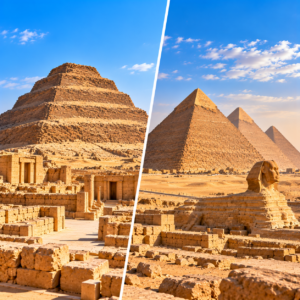
Egypt is home to some of the world’s most remarkable ancient monuments, but not every pyramid site offers the same experience. Two of the most important places to explore are Saqqara and Giza, both located within the wider archaeological landscape of ancient Memphis near Cairo.
Giza is famous for its enormous pyramids, the Great Sphinx, and the spectacular skyline that has become one of Egypt’s most recognizable images. Saqqara offers a different experience, taking visitors back to an earlier stage of pyramid construction through the Step Pyramid of Djoser, ancient tombs, underground burial galleries, and monuments from several periods of Egyptian history.
So, which should you visit: Saqqara or Giza?
The answer depends on your interests, available time, and whether this is your first trip to Egypt. If you want to see the country’s most famous pyramids, Giza is the obvious starting point. If you want to understand how pyramid building began and explore a wider archaeological site, Saqqara may be the more rewarding choice.
Ideally, visit both. Together, they tell a much more complete story of ancient Egyptian architecture and royal burial traditions.
Saqqara vs Giza: The Main Differences
Before deciding where to go, it helps to understand what makes each site special.
| Feature | Saqqara | Giza |
|---|---|---|
| Most famous monument | Step Pyramid of Djoser | Great Pyramid of Khufu |
| Main attraction | Early pyramid architecture and ancient tombs | Three monumental royal pyramids and the Great Sphinx |
| Historical focus | The development of pyramid construction and funerary architecture | The great pyramid-building achievements of the Fourth Dynasty |
| Other highlights | Pyramid of Unas, noble tombs, Serapeum, Imhotep Museum | Sphinx, queens’ pyramids, royal cemeteries, mortuary temples |
| Visitor experience | Broad archaeological landscape with many different monuments | Iconic monuments concentrated around the Giza Plateau |
| Best for | History enthusiasts and travelers seeking archaeological variety | First-time visitors and travelers wanting Egypt’s most famous landmarks |
| Suggested time | Around 3–5 hours for selected highlights | Around 3–5 hours for a substantial visit |
| Can you visit both in one day? | Yes, with careful planning | Yes, with careful planning |
Neither site is simply a smaller or better version of the other. Giza offers the monumental scale most travelers associate with Egypt, while Saqqara provides a deeper look at the earlier stages of pyramid construction and the wider world surrounding ancient royal burials.
Why Visit the Pyramids of Giza?
The Giza Plateau is usually the first pyramid destination travelers consider, and for good reason. It contains the Great Pyramid of Khufu, the Pyramid of Khafre, the Pyramid of Menkaure, and the famous Great Sphinx.
These monuments were built during Egypt’s Fourth Dynasty, more than 4,500 years ago. The Great Pyramid is the largest of the three main pyramids and the only surviving member of the Seven Wonders of the Ancient World.
For many visitors, seeing the pyramids in person is a major reason for traveling to Egypt. Their enormous scale is difficult to appreciate through photographs alone.
1. See the Great Pyramid of Khufu
The Great Pyramid is the main attraction at Giza. Built as the royal tomb of King Khufu, it was originally approximately 146.5 meters tall and remained the tallest human-made structure in the world for thousands of years.
Visitors can admire its exterior, walk around parts of the complex, and explore the surrounding archaeological landscape. Entry into the pyramid’s interior may also be available with the appropriate ticket, subject to current access rules.
Inside, visitors encounter ascending passages, the Grand Gallery, and the King’s Chamber. The experience is physically demanding in places, with narrow passages and steep sections, so it is worth considering your comfort and mobility before buying an interior ticket.
2. Photograph the Great Sphinx
The Great Sphinx is one of Egypt’s most recognizable monuments. Carved from limestone bedrock, it has the body of a lion and a human head and stands beside the pyramid complex associated with King Khafre.
The Sphinx provides a different perspective on Giza’s monumental architecture. It is also one of the most popular photography stops, especially for travelers who want pictures that combine the sculpture with the pyramids in the background.
Allow time to see the Sphinx area rather than focusing only on the three main pyramids.
3. Explore More Than the Three Pyramids
The Giza Plateau contains much more than the famous structures visible in most photographs. The wider complex includes smaller pyramids, tombs, remains of temples, and archaeological areas connected with royal families and the people who supported the pyramid projects.
If you are interested in ancient Egyptian society, these additional remains help put the main monuments into context.
A guided tour can be useful if you want to understand the relationships between the pyramids, temples, cemeteries, and surrounding landscape.
4. Enjoy the Iconic Desert Views
Giza is also an excellent destination for photography. The pyramids can be viewed from different positions across the plateau, allowing you to capture their scale and their relationship to the surrounding desert.
Visit early if you want to avoid the strongest midday heat and have more comfortable conditions for walking. The site can become busy, especially during popular travel periods.
Choose Giza if: this is your first trip to Egypt, you want to see the most famous pyramids, or you are particularly interested in the Great Sphinx and the Great Pyramid’s interior.
Why Visit Saqqara?
Saqqara offers a different kind of archaeological experience. It is one of the most important ancient burial grounds associated with Memphis and contains monuments built over a long period of Egyptian history.
Its best-known landmark is the Step Pyramid of Djoser, a structure that represents a major turning point in the development of monumental stone architecture.
Unlike a visit focused mainly on a few enormous pyramids, exploring Saqqara can involve several different types of monuments, including royal pyramids, decorated tombs, underground galleries, and a museum.
1. Discover the Step Pyramid of Djoser
The Step Pyramid is Saqqara’s defining monument. Built for King Djoser during the Third Dynasty, it consists of six stacked levels that create its distinctive stepped profile.
The pyramid is generally regarded as the earliest major stone pyramid in Egypt and a landmark in the evolution of royal funerary architecture. Its design is traditionally associated with the architect Imhotep.
Before the development of the smooth-sided pyramids, royal and elite burials often used structures known as mastabas. The Step Pyramid transformed this architectural tradition into a monumental form that helped prepare the way for later pyramid designs.
For travelers interested in ancient engineering, Saqqara offers an opportunity to explore the beginnings of pyramid construction rather than only its most famous achievements.
2. Visit Ancient Tombs with Detailed Decorations
One of Saqqara’s greatest advantages is its collection of non-royal tombs. Some contain carved or painted scenes that depict aspects of daily life, including agriculture, food preparation, fishing, and animal husbandry.
These decorations provide a different perspective from the monumental pyramids. They help visitors imagine the people, occupations, beliefs, and social structures that existed in ancient Egypt.
Depending on current opening arrangements and the tickets you purchase, you may be able to visit selected tombs, including the Tomb of Mereruka.
If you enjoy detailed artwork and historical interpretation, these tombs can be among the most memorable parts of a Saqqara visit.
3. Explore the Pyramid of Unas
The Pyramid of Unas is another important monument at Saqqara. It is particularly notable for the Pyramid Texts inscribed inside its burial chambers.
These ancient religious texts were intended to help the king in the afterlife and are important for understanding Egyptian beliefs about death, kingship, and the next world.
The Pyramid of Unas is not as visually imposing as the Great Pyramid at Giza, but its historical and religious significance makes it an important stop for visitors interested in ancient Egyptian culture.
Confirm interior access before planning your visit, as access to individual monuments can change.
4. See the Serapeum
The Serapeum is an underground complex associated with the burial of sacred Apis bulls. Its large galleries and burial chambers provide a different experience from exploring a royal pyramid.
The complex reflects the religious traditions associated with the Apis bull cult and adds another dimension to Saqqara’s archaeological importance.
If the Serapeum is open during your visit, it can be a valuable addition to an itinerary focused on ancient Egyptian religion and burial practices.
5. Visit the Imhotep Museum
The Imhotep Museum provides context for the archaeological discoveries made at Saqqara. Its collections include objects connected with the site’s long history and the monuments surrounding it.
A museum visit can help you understand the construction techniques, artifacts, and funerary traditions you encounter outdoors.
Whether you include the museum depends on your schedule and interests, but it can be especially worthwhile if you want more than photographs of the pyramids.
Choose Saqqara if: you are interested in archaeology, ancient tombs, early pyramid design, religious texts, or discovering monuments beyond Egypt’s most famous landmarks.
Which Site Has the More Impressive Pyramids?
This depends on what you mean by impressive.
Giza wins in terms of monumental scale and international recognition. The Great Pyramid is an extraordinary feat of engineering, and seeing the three main pyramids together is one of Egypt’s defining travel experiences.
Saqqara is more compelling if you want to understand how that architectural tradition developed. The Step Pyramid shows an earlier stage of pyramid construction, while other monuments at the site reveal how royal and elite burial practices evolved over time.
Think of the two destinations as different chapters in the same story.
At Saqqara, you can explore the early development of monumental stone architecture. At Giza, you can see the extraordinary scale that pyramid construction eventually achieved.
Saqqara vs Giza: Which Is Better for History Lovers?
Both sites are excellent for history lovers, but they offer different kinds of information.
At Giza, the focus is on the Fourth Dynasty’s major royal pyramid complexes. You can learn about the kings who commissioned them, the construction challenges involved, and the temples and cemeteries associated with the monuments.
At Saqqara, the archaeological picture is broader. The site includes monuments from different periods, royal pyramids, decorated tombs, religious burial complexes, and evidence of changing funerary traditions.
If you want to understand the development of ancient Egyptian civilization over a longer period, Saqqara may provide more variety. If you want to focus on the scale and achievement of the great pyramids, Giza is the stronger choice.
For a balanced introduction to ancient Egypt, visiting both is ideal.
Which Site Is Better for Photography?
Giza is usually the better choice for travelers who want classic pyramid photographs. The Great Pyramid, the other two main pyramids, and the Sphinx provide instantly recognizable subjects.
The plateau also offers a range of viewpoints, including scenes that show several pyramids in the same frame.
Saqqara offers a different visual experience. The Step Pyramid has a distinctive stepped profile, while the wider archaeological landscape includes tomb entrances, ancient stonework, and desert surroundings.
The choice depends on the kind of photographs you want:
- Giza: iconic pyramid views, the Great Sphinx, and large-scale desert panoramas.
- Saqqara: early pyramid architecture, decorated tombs, archaeological details, and less familiar monuments.
Photography rules may differ between monuments and interior spaces, so check current restrictions before using specialist equipment.
Saqqara vs Giza: Tickets and Opening Hours
Ticket prices and access arrangements can change. Check the official Ministry of Tourism and Antiquities listings before your visit, especially if you plan to enter a pyramid or explore additional tombs.
The Ministry’s current online listings show the following general site-admission prices for foreign adult visitors:
| Site | Published general admission |
|---|---|
| Giza Plateau | EGP 700 |
| Saqqara archaeological area | EGP 600 |
These are general site-admission prices, not a like-for-like total for every experience. At Giza, entry to the interiors of major pyramids is charged separately. At Saqqara, some tombs, monuments, and special areas have separate tickets, while an inclusive ticket may cover a selected group of attractions.
The Ministry’s listings currently show standard opening hours of 8:00 AM to 4:00 PM for both the Giza Plateau and the Saqqara archaeological area. However, individual monument pages may display different hours, and arrangements can change during Ramadan or for operational reasons.
Official information:
- Giza Plateau — Ministry of Tourism and Antiquities
- Saqqara — Ministry of Tourism and Antiquities
- Step Pyramid Complex of Djoser — Ministry of Tourism and Antiquities
Check which attractions are included in your ticket before entering either site. If your priority is going inside a pyramid or visiting a particular tomb, verify access for that specific monument.
How Much Time Do You Need at Each Site?
The amount of time you need depends on how many monuments you want to see and whether you plan to enter any interiors.
Giza: Around 3–5 Hours
Allow around three to five hours for a substantial visit to the Giza Plateau. This gives you time to see the main pyramids, visit the Sphinx area, take photographs, and explore some of the surrounding archaeological remains.
If you want to enter the Great Pyramid or another pyramid when access is available, allow additional time for ticketing, queues, and the interior visit.
Travelers with a strong interest in archaeology may prefer to spend longer at Giza.
Saqqara: Around 3–5 Hours
Saqqara also deserves several hours. You can spend time at the Step Pyramid complex, select additional tombs, and explore other monuments according to your interests and the available opening arrangements.
Because the site covers a broad archaeological landscape, it helps to decide which monuments matter most to you before arriving.
A guided tour can make it easier to choose a realistic route and understand the historical significance of the different stops.
Can You Visit Both in One Day?
Yes, but the day can feel rushed if you want to explore both sites in depth.
Visiting Giza and Saqqara on the same day is more practical if you arrange transportation in advance and select a limited number of priorities. Trying to see every major monument, enter multiple interiors, and spend time at museums may require more time than one day comfortably allows.
If you have only one day for pyramids, choose the site that best matches your interests. If you have two days, dedicate one to Giza and another to Saqqara, with Dahshur as an additional option if your schedule permits.
Can You Visit Saqqara, Giza, and Dahshur on the Same Trip?
Absolutely. These three destinations complement one another and are all part of the wider archaeological landscape associated with ancient Memphis.
Each site highlights a different part of the story:
- Saqqara: the Step Pyramid and the early development of monumental stone architecture.
- Dahshur: the Bent Pyramid and Red Pyramid, which reveal important stages in the development of smooth-sided pyramids.
- Giza: the monumental pyramids of Khufu, Khafre, and Menkaure, along with the Great Sphinx.
If you have several days in Cairo, visiting all three provides a much richer understanding of ancient Egyptian pyramid construction.
A practical approach is to visit Giza on one day, then combine Saqqara and Dahshur on another. This allows you to spend more time at each site without rushing through the monuments.
Practical Tips for Visiting Saqqara and Giza
A few simple preparations can make either visit more comfortable.
Start early. Morning visits are often more comfortable because the monuments are exposed to the sun and shade can be limited.
Wear comfortable shoes. Both sites involve walking across large archaeological areas. Some surfaces are uneven, sandy, or dusty.
Bring water and sun protection. A hat, sunglasses, and sunscreen are useful, especially during warmer months.
Arrange transportation in advance. A private driver or organized tour can simplify the journey, particularly if you want to visit several archaeological sites in one day.
Check tickets carefully. General admission may not include every pyramid interior, tomb, or special monument.
Consider a guide. A knowledgeable guide can explain the historical differences between the sites and help you understand details you might otherwise miss.
Avoid overplanning. Choose a few priorities instead of trying to see every monument in a single visit.
Final Verdict: Should You Visit Saqqara or Giza?
For most first-time visitors to Egypt, Giza should come first. The Great Pyramid, the other two main pyramids, and the Great Sphinx are among the country’s most famous landmarks and deserve a place on a first itinerary.
However, Saqqara should not be treated as an optional extra for history enthusiasts alone. Its Step Pyramid, decorated tombs, Pyramid Texts, and wider archaeological landscape provide a different perspective on ancient Egypt.
If you have enough time, visit both. Giza shows the monumental achievements of the great pyramid builders, while Saqqara helps explain the earlier architectural and religious traditions that shaped those achievements.
And if you have an additional day, consider Dahshur. The Bent Pyramid and Red Pyramid add another important chapter to the story.
Together, these sites make it possible to explore the evolution of ancient Egyptian pyramid construction rather than seeing only its most famous monuments.